
The market they’re operating in is as competitive as it’s ever been. Software startups pulled in $8.98 billion in a single quarter, nearly twice any other sector in 2025, making software the single biggest destination for venture money.
But the broader picture is more complicated: global startup funding hit $425 billion across more than 24,000 companies in 2025, up 30% on the year, while that capital concentrated into fewer, larger rounds.
For early and mid-stage SaaS companies, that means more competition for less available money, which puts a premium on building real, organic demand rather than buying it.
So the question we set out to answer is: which software companies, across every category from dev tools to fintech to creative software to security, are actually growing demand right now?
This article was researched and built by Agent A, Ahrefs’ AI agent. Agent A pulls live Ahrefs data, runs its own analysis, and assembles findings like the ranking below, so the numbers you’re about to read come straight from the same data set our tools run on.

You can recreate this kind of research for your specific niche or vertical using Agent A.
Here are the 25 fastest growing SaaS companies ranked by five-year growth in brand-name searches, from the steepest climb down, each with a trend chart, the key numbers, and a short read on what’s driving their growth.
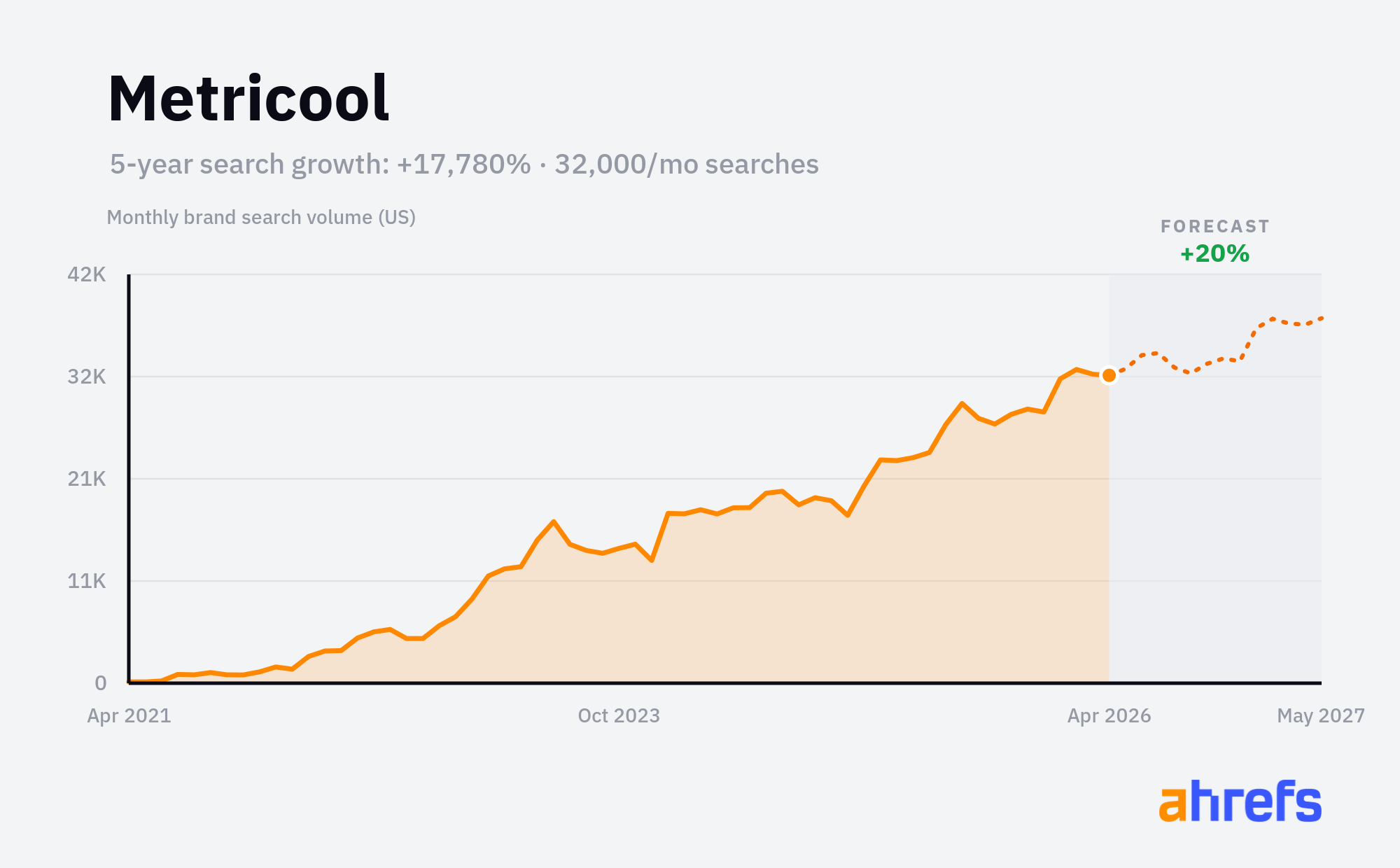
- Brand search growth (5-year): +17,780%
- 1-year search growth: +40%
- Search growth forecast: +20%
- Monthly brand searches: 32,000
- Organic traffic (monthly): 776,865
- Year founded: 2015
- Location: Madrid, Spain
What they do
Metricool is a social media management and analytics platform used by individual creators, marketing agencies, and brands to schedule content, manage paid ads, and measure performance across channels from a single dashboard.
Since 2022, the company has raised around €5M in total disclosed funding, from Axon Partners Group.
Metricool tops this list of fastest growing SaaS companies with +17,780% brand search growth over five years, which is an extraordinary number for a social media tool competing in a genuinely crowded space. The platform’s combination of a generous free tier, strong multilingual reach, and positioning as an all-in-one alternative to pricier tools has driven word-of-mouth adoption across both Spanish-speaking and English-speaking markets, and that audience has only kept growing.
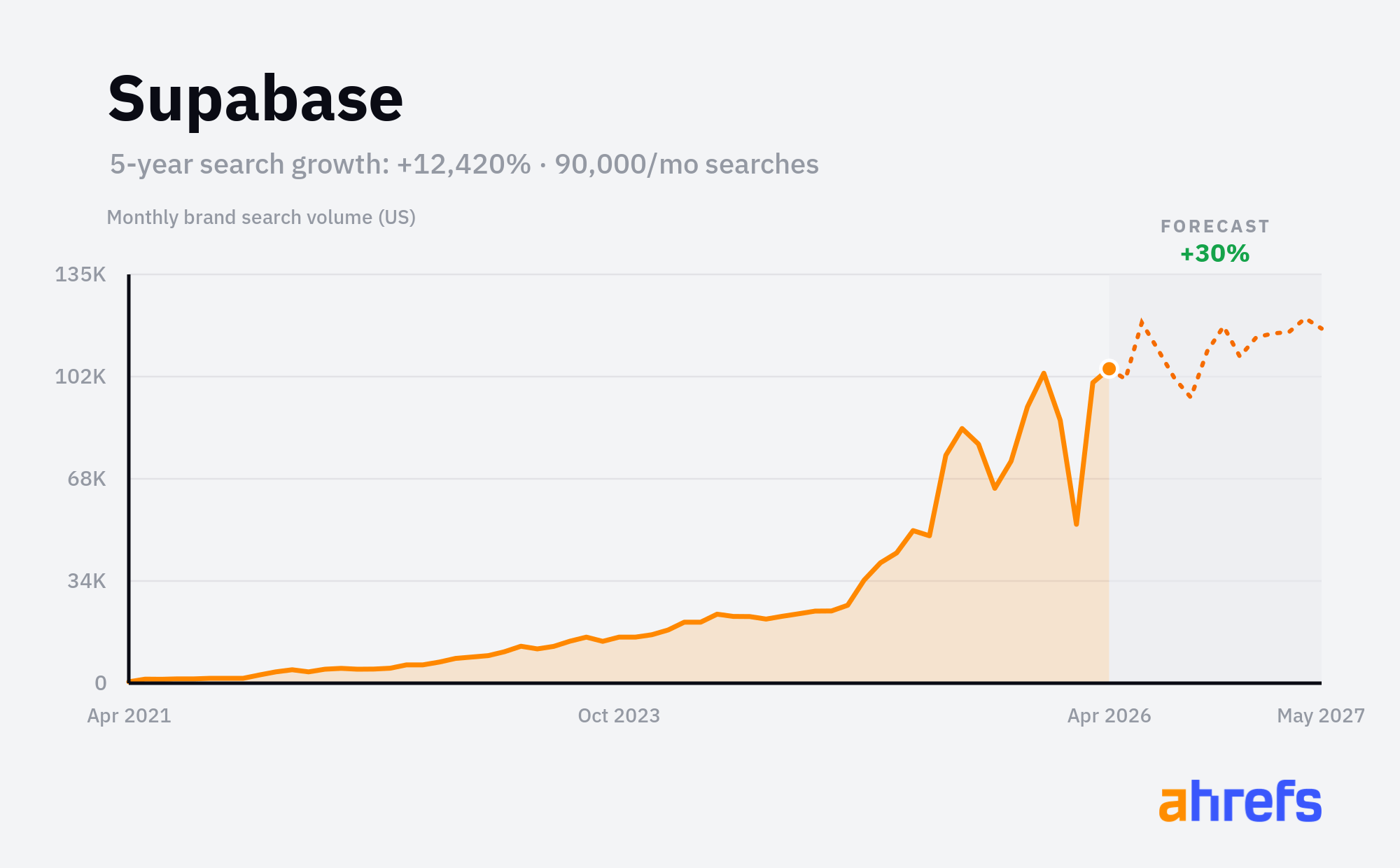
- Brand search growth (5-year): +12,420%
- 1-year search growth: +80%
- Search growth forecast: +30%
- Monthly brand searches: 90,000
- Organic traffic (monthly): 1,012,730
- Year founded: 2020
- Location: Singapore
What they do
Supabase needs little introduction: it’s the open-source Firebase alternative that gives developers a Postgres database, authentication, instant APIs, and real-time subscriptions, and it’s become one of the most talked-about developer tools of the past few years.
The company has raised over $500 million in total funding, including a $100M Series E co-led by Accel and Peak XV in October 2025, on top of a $200M Series D led by Accel earlier that year.
+12,420% five-year brand search growth puts Supabase second on this list, and it’s not hard to see why. The developer tooling wave of the past few years rewarded open-source projects that lowered the barrier to building production-grade backends, and Supabase landed right at the center of that shift. With 90K monthly brand searches and an 80% jump in just the last year, demand is still accelerating.
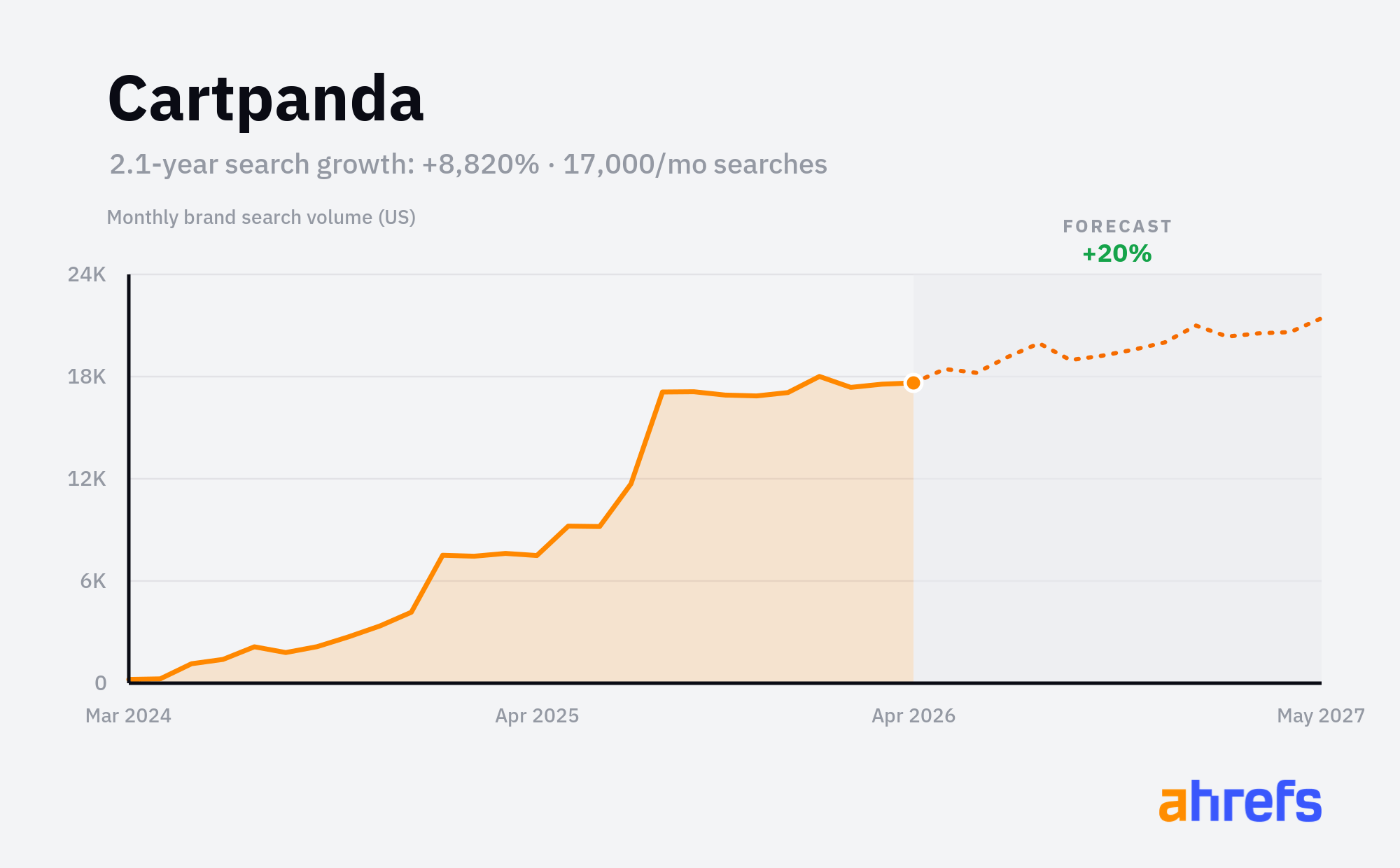
- Brand search growth (2.1-year): +8,820%
- 1-year search growth: +120%
- Search growth forecast: +20%
- Monthly brand searches: 17,000
- Organic traffic (monthly): 31,769
- Year founded: 2019
- Location: Delaware
What they do
Cartpanda is a Brazilian e-commerce platform that lets merchants build and run online stores, manage checkout, and process payments, primarily serving sellers in the Brazilian digital commerce market.
Cartpanda has raised $125,000 in disclosed funding, from Y Combinator, in a seed round in June 2021.
+8,820% growth over roughly two years is the kind of number that demands an explanation, and the short version is Brazil’s e-commerce market. Digital commerce in Brazil has expanded rapidly, and Cartpanda has grown alongside it by offering a localized checkout and payments experience that fits how Brazilian merchants actually operate. The +120% one-year growth figure suggests the momentum hasn’t peaked yet.
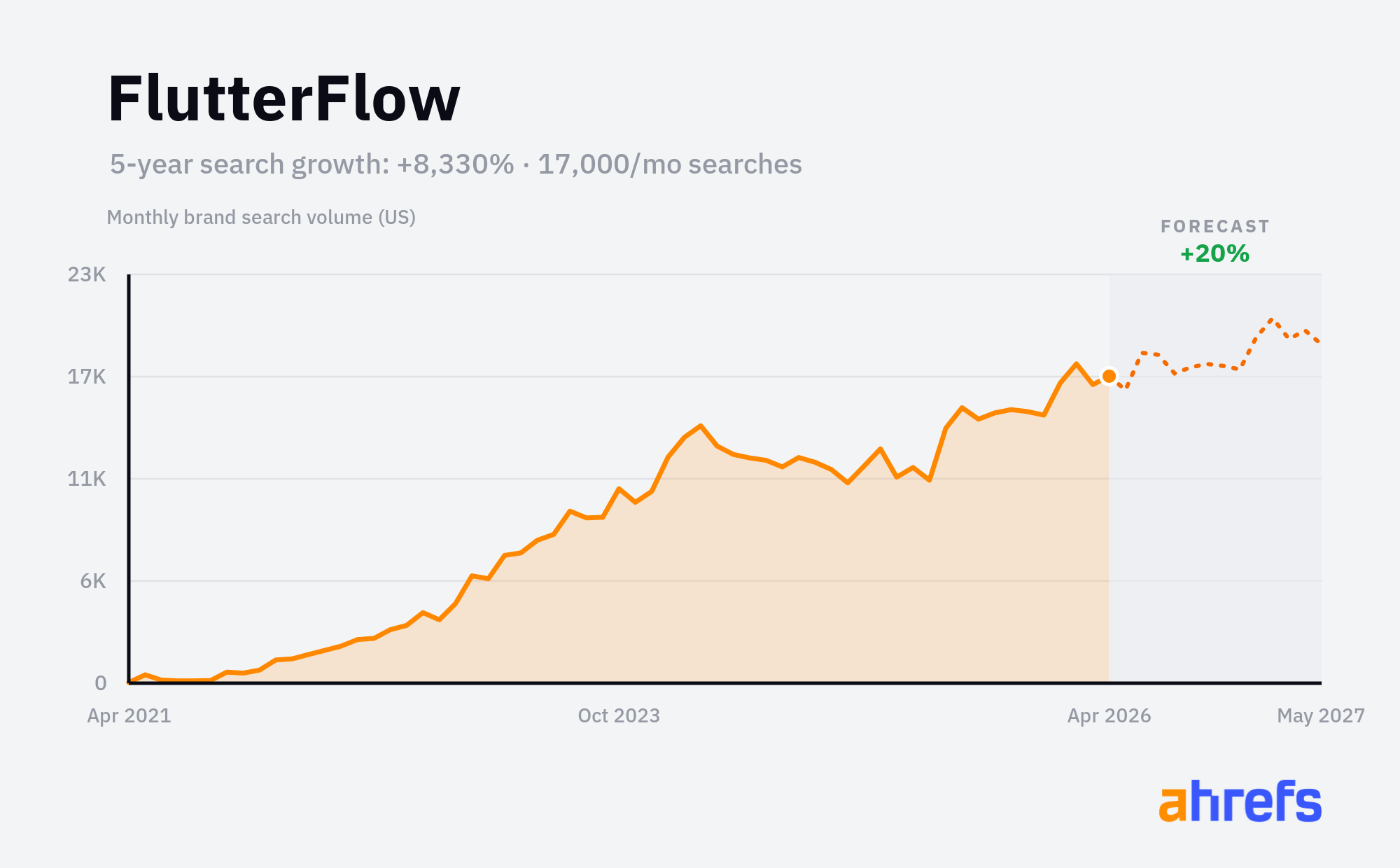
- Brand search growth (5-year): +8,330%
- 1-year search growth: +50%
- Search growth forecast: +20%
- Monthly brand searches: 17,000
- Organic traffic (monthly): 436,218
- Year founded: 2020
- Location: Mountain View, CA
What they do
FlutterFlow is a visual app-building platform that lets teams design and ship native mobile and web apps without writing most of the code, built on top of Google’s Flutter framework.
The company raised a $25.5M Series A in January 2024, led by GV and Gradient Ventures, bringing total funding to approximately $30 million.
The low-code and no-code category has been building momentum for years, but FlutterFlow carved out a specific niche by targeting developers and technical teams who want to move faster without fully leaving the world of real code. +8,330% over five years reflects genuine category growth combined with a product that’s earned a real following among builders who’d otherwise be writing Flutter from scratch.
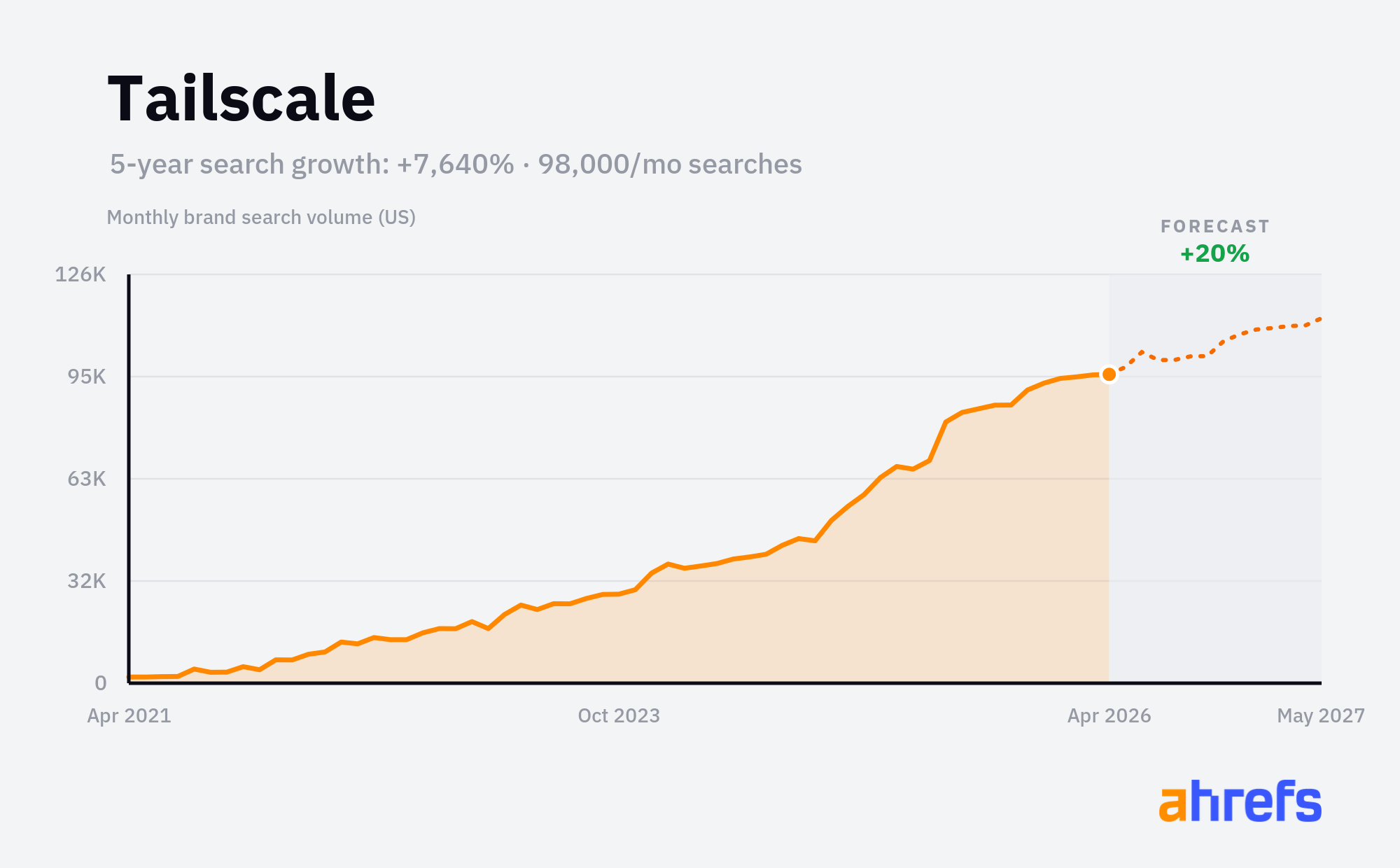
- Brand search growth (5-year): +7,640%
- 1-year search growth: +40%
- Search growth forecast: +20%
- Monthly brand searches: 98,000
- Organic traffic (monthly): 329,358
- Year founded: 2019
- Location: Toronto, Ontario
What they do
Tailscale needs little introduction in developer circles: it’s the mesh VPN built on WireGuard that lets teams connect devices and services securely without the headache of traditional corporate network setup.
Tailscale has raised $275 million in total funding, most recently a $160M Series C in April 2025 led by Accel, valuing the company at approximately $1.5 billion.
Remote and hybrid work fundamentally changed what people need from network security, and Tailscale was in exactly the right place when that shift happened. ~100K monthly brand searches and +7,640% five-year growth are a good indicator of how thoroughly the product has spread through engineering teams, mostly by word of mouth from people who tried it and immediately recommended it to everyone they knew.
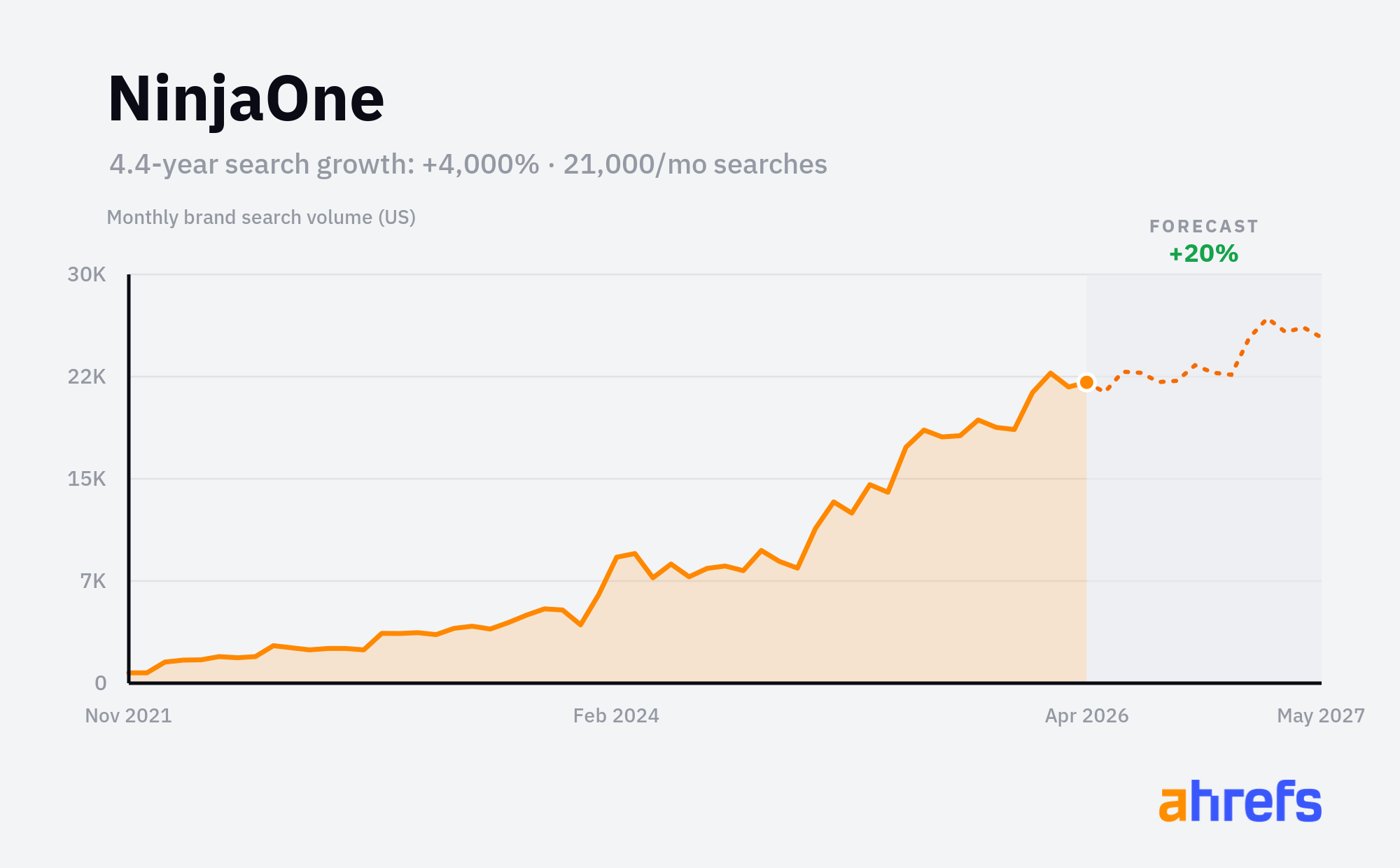
- Brand search growth (4.4-year): +4,000%
- 1-year search growth: +60%
- Search growth forecast: +20%
- Monthly brand searches: 21,000
- Organic traffic (monthly): 250,141
- Year founded: 2013
- Location: Austin, Texas
What they do
NinjaOne is an IT management platform used by managed service providers and internal IT teams to monitor, manage, and secure endpoints across their environments.
NinjaOne has raised $761.5 million in total disclosed funding, including a $500M Series C extension in February 2025 led by ICONIQ Growth and CapitalG; CNBC reported in January 2026 that the company had crossed $500 million in ARR.
+4,000% growth over roughly five years is a strong result in IT management, a category that tends to grow through IT team networks and G2 rankings rather than splashy consumer campaigns. NinjaOne has leaned into that, building a reputation for support quality and usability that its competitors have found hard to match, and the +60% one-year growth suggests the compounding hasn’t slowed.
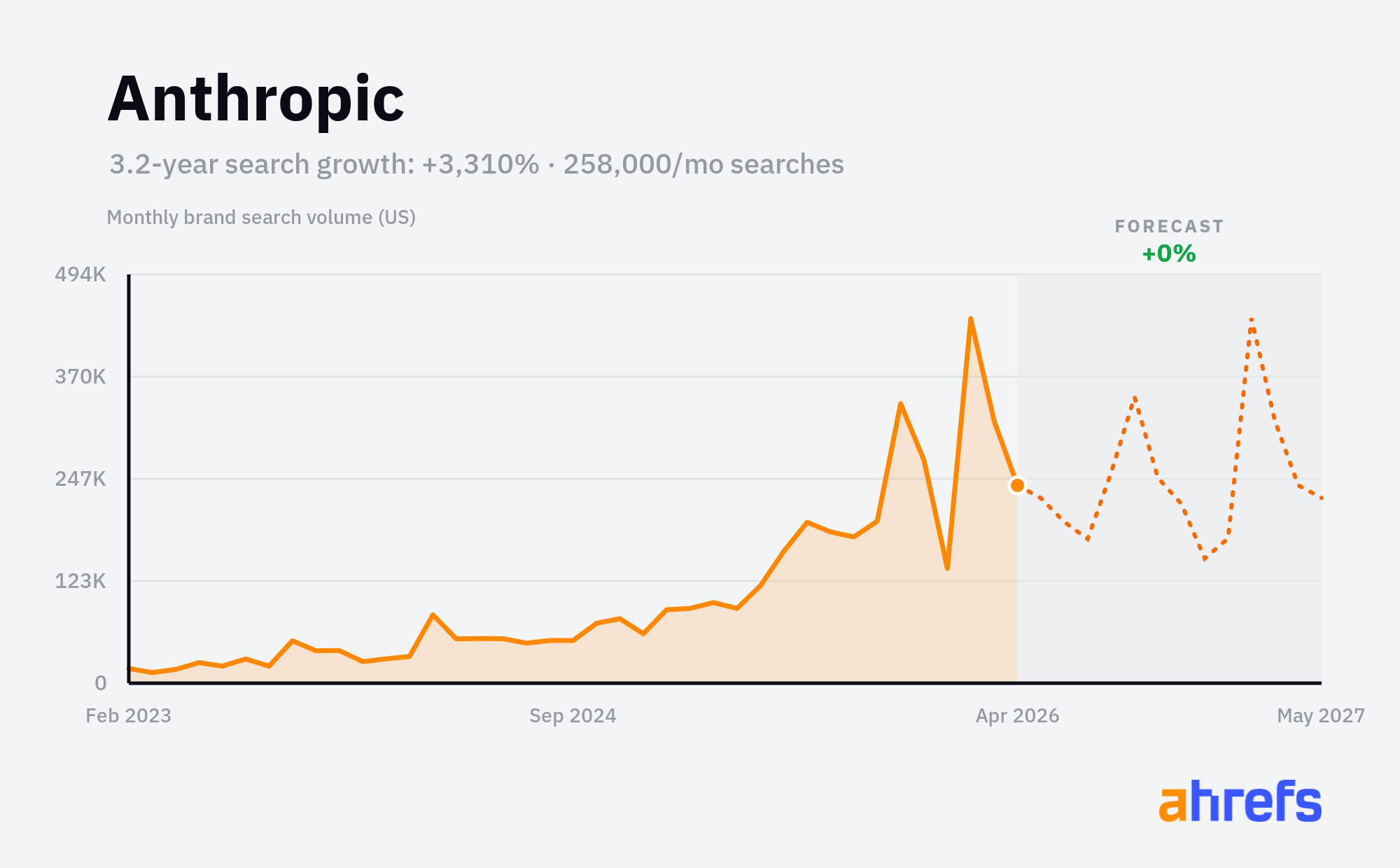
- Brand search growth (3.2-year): +3,310%
- 1-year search growth: +230%
- Search growth forecast: +0%
- Monthly brand searches: 258,000
- Organic traffic (monthly): 1,481,007
- Year founded: 2021
- Location: San Francisco, United States
What they do
Anthropic needs little introduction: it’s the AI safety company behind the Claude family of models, used by developers, enterprises, and consumers across a wide range of applications.
Anthropic’s funding history is at a different scale than almost anything else on this list. The company has raised tens of billions across multiple rounds, most recently a $65 billion Series H led by Altimeter Capital, Dragoneer, Greenoaks, and Sequoia Capital.
+3,310% brand search growth over roughly four years, with 258K monthly searches and a 230% jump in the past year alone, reflects one of the fastest brand-building trajectories in recent software history. Claude’s rise from a lesser-known research project to a serious competitor in the consumer and enterprise AI market has happened in a remarkably short window.
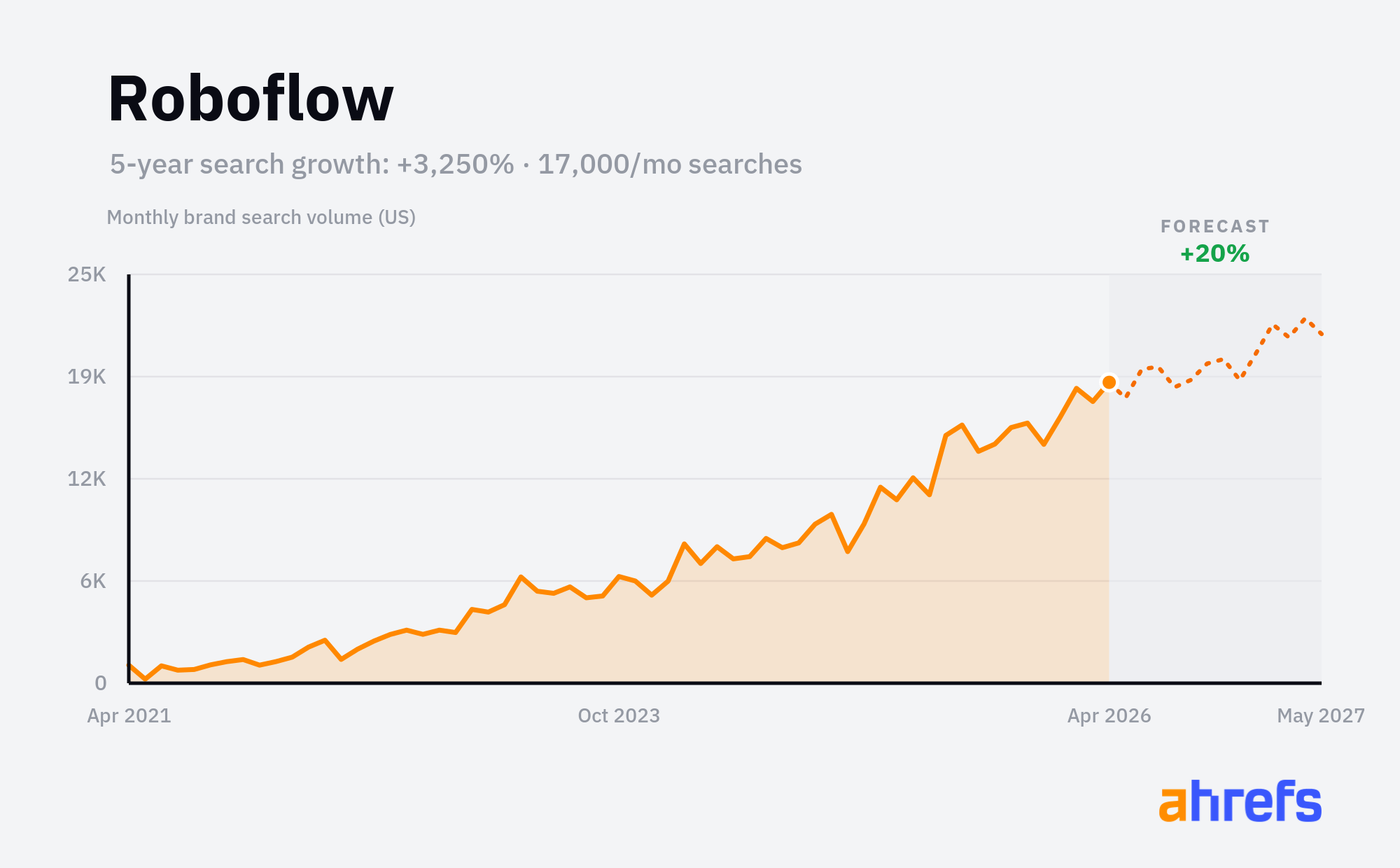
- Brand search growth (5-year): +3,250%
- 1-year search growth: +50%
- Search growth forecast: +20%
- Monthly brand searches: 17,000
- Organic traffic (monthly): 267,019
- Year founded: 2019
- Location: Des Moines, United States
What they do
Roboflow is a computer vision platform used by developers and data science teams to manage image datasets, annotate and label data, train models, and deploy them via API or to the edge.
Roboflow has raised $62.75 million in total venture funding, including a $40M Series B in November 2024 led by GV, with participation from Craft Ventures and Y Combinator.
Computer vision went from a specialist discipline to a mainstream development task remarkably quickly, and Roboflow built the tooling that made it accessible to the developers who weren’t ML researchers. +3,250% five-year brand search growth is a reflection of that category expanding outward, with Roboflow sitting at the center as the practical choice for teams who need to get a vision model into production without building all the infrastructure from scratch.
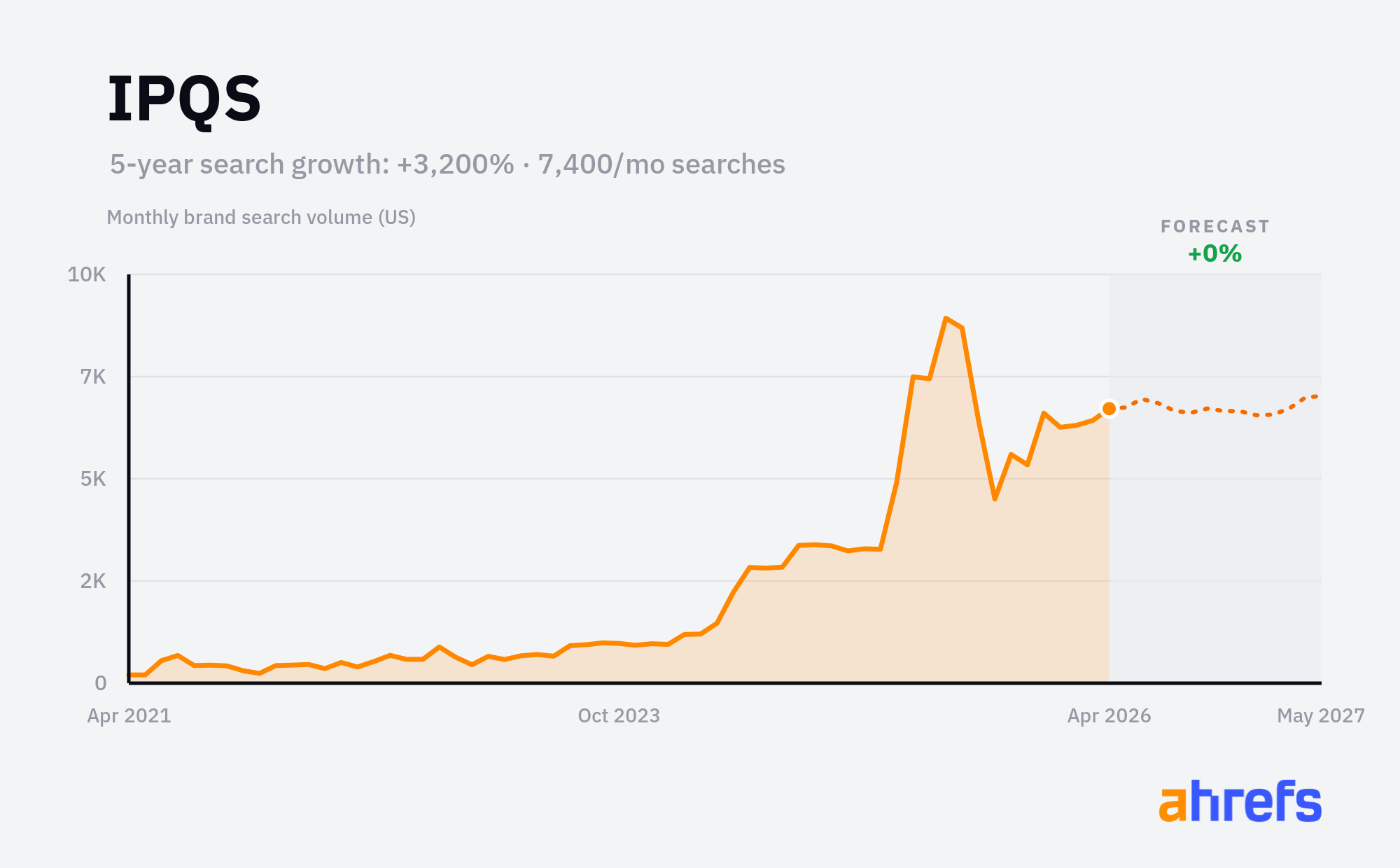
- Brand search growth (5-year): +3,200%
- 1-year search growth: -0%
- Search growth forecast: +0%
- Monthly brand searches: 7,400
- Organic traffic (monthly): 268,193
- Year founded: 2011
- Location: Las Vegas, NV
What they do
IPQS is a fraud prevention platform that provides IP reputation scoring, device fingerprinting, email and phone validation, and bot detection to businesses protecting their platforms from abuse and fraudulent traffic.
IPQS has no disclosed venture funding and appears to be bootstrapped.
+3,200% five-year brand search growth from a bootstrapped fraud detection tool is a genuinely interesting result. IPQS has grown by making its core APIs easy to integrate and pricing them accessibly enough that developers reach for them without a lengthy procurement process. The flat 1-year trend suggests the brand has found a stable audience rather than a continuing growth surge, but the five-year arc tells a story of a product that quietly built real traction.
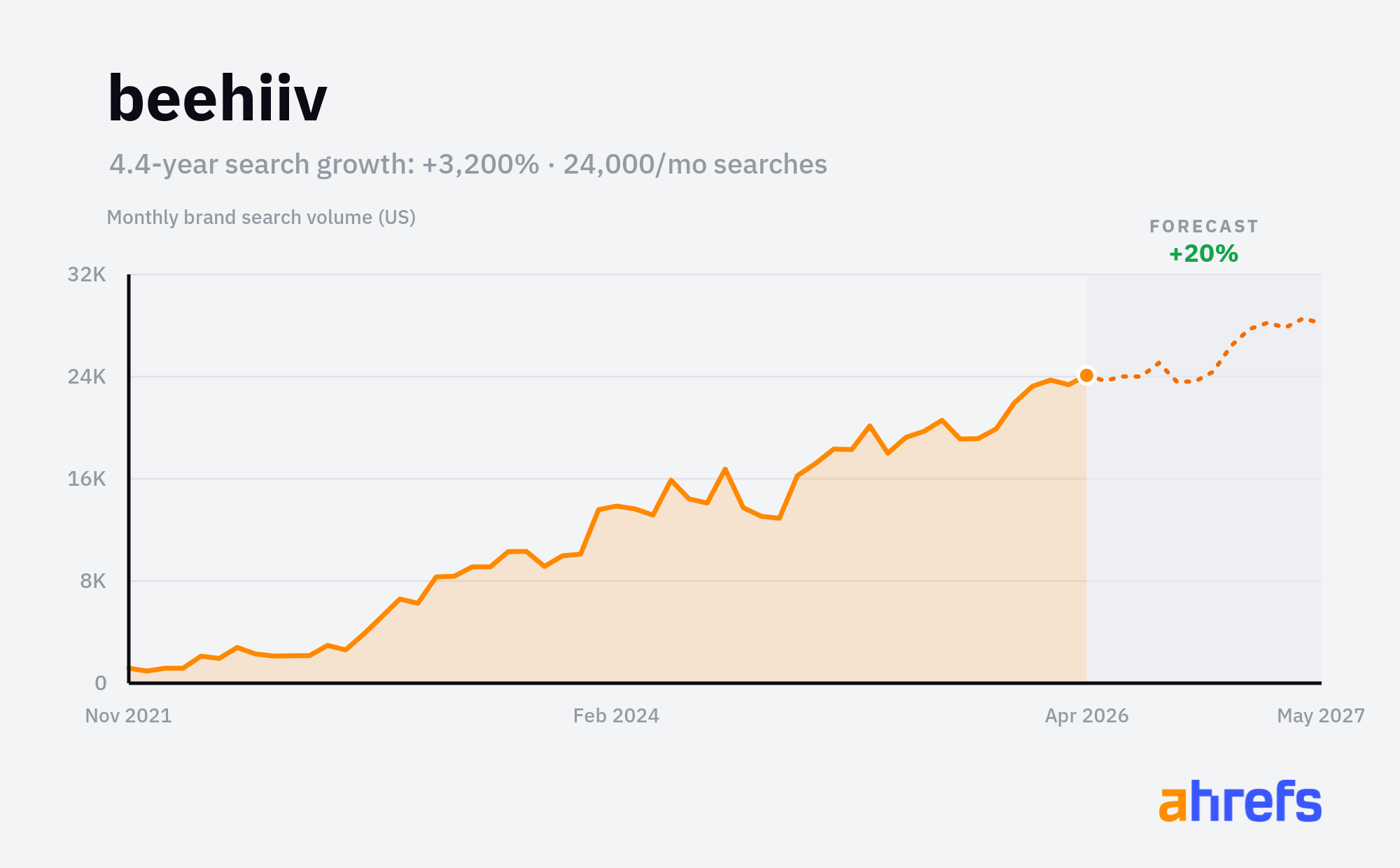
- Brand search growth (4.4-year): +3,200%
- 1-year search growth: +30%
- Search growth forecast: +20%
- Monthly brand searches: 24,000
- Organic traffic (monthly): 282,455
- Year founded: 2021
- Location: New York, New York
What they do
beehiiv is a newsletter publishing and monetization platform, built by the team behind the Morning Brew newsletter, that gives creators and media businesses tools to grow, segment, and monetize their subscriber lists.
beehiiv has raised $49.7 million in total funding, including a $33M Series B in April 2024 led by Lightspeed Venture Partners, with participation from NEA and Sapphire Ventures.
The newsletter renaissance of the past few years created real demand for a platform that took the medium seriously as a business, and beehiiv filled that gap with a product built by people who actually ran a large newsletter. +3,200% growth over roughly five years reflects both the broader creator economy tailwind and a genuine product advantage over older platforms that weren’t designed with monetization at their core.
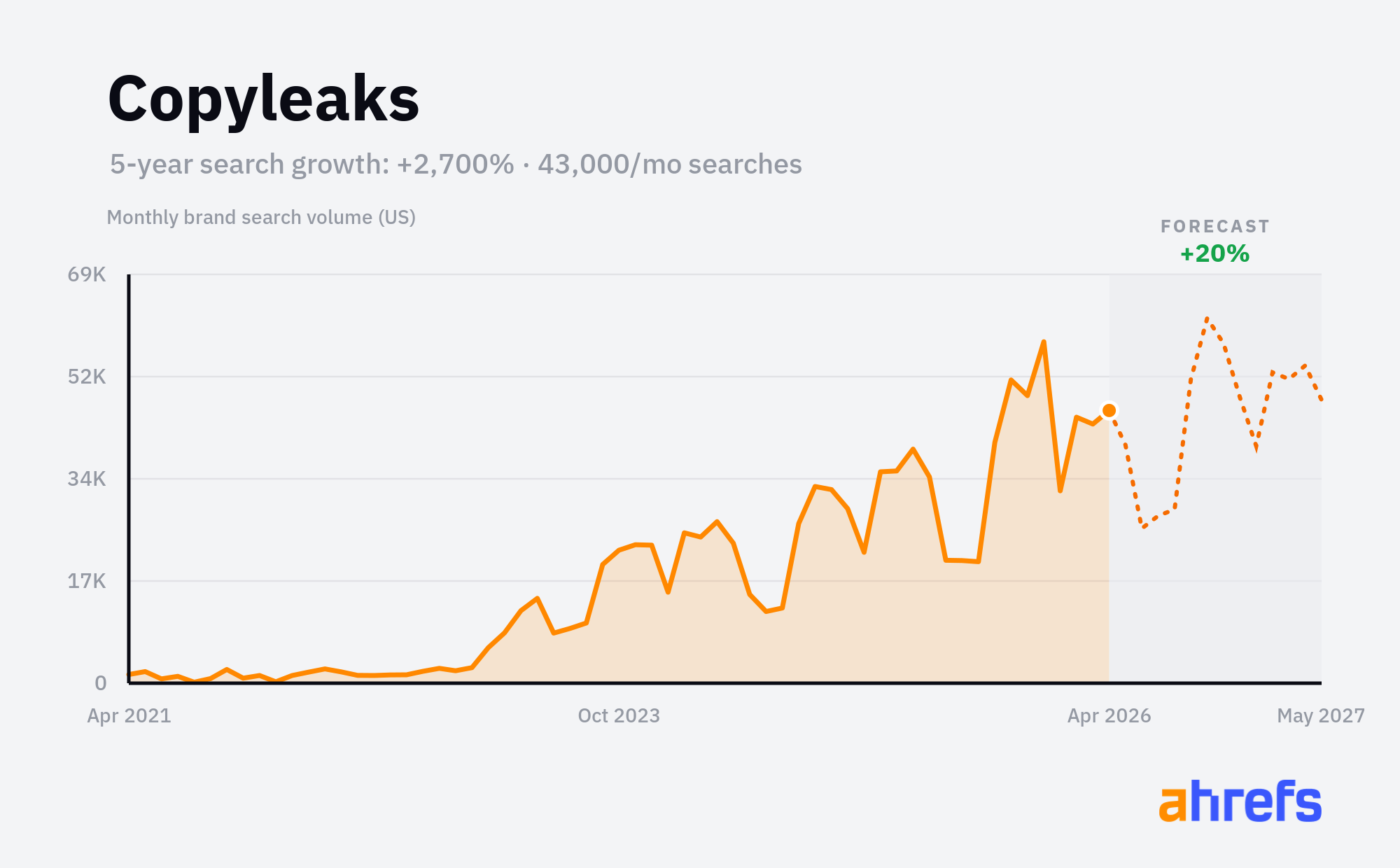
- Brand search growth (5-year): +2,700%
- 1-year search growth: +20%
- Search growth forecast: +20%
- Monthly brand searches: 43,000
- Organic traffic (monthly): 1,664,710
- Year founded: 2015
- Location: New York, New York
What they do
Copyleaks is a text analysis platform used by educational institutions and businesses to detect plagiarism and identify AI-generated content in documents and written work.
Copyleaks has raised approximately $7.75 million in total disclosed funding, including a $6M Series A in May 2022 led by JAL Ventures.
Copyleaks was a plagiarism detection tool before AI writing exploded the demand for exactly that kind of product. When institutions and organizations started asking hard questions about the provenance of written content, Copyleaks was already in the market with a working product and a recognizable name. The +2,700% five-year growth and 1.7M monthly organic visits reflect a platform that caught a very large wave at a useful moment.
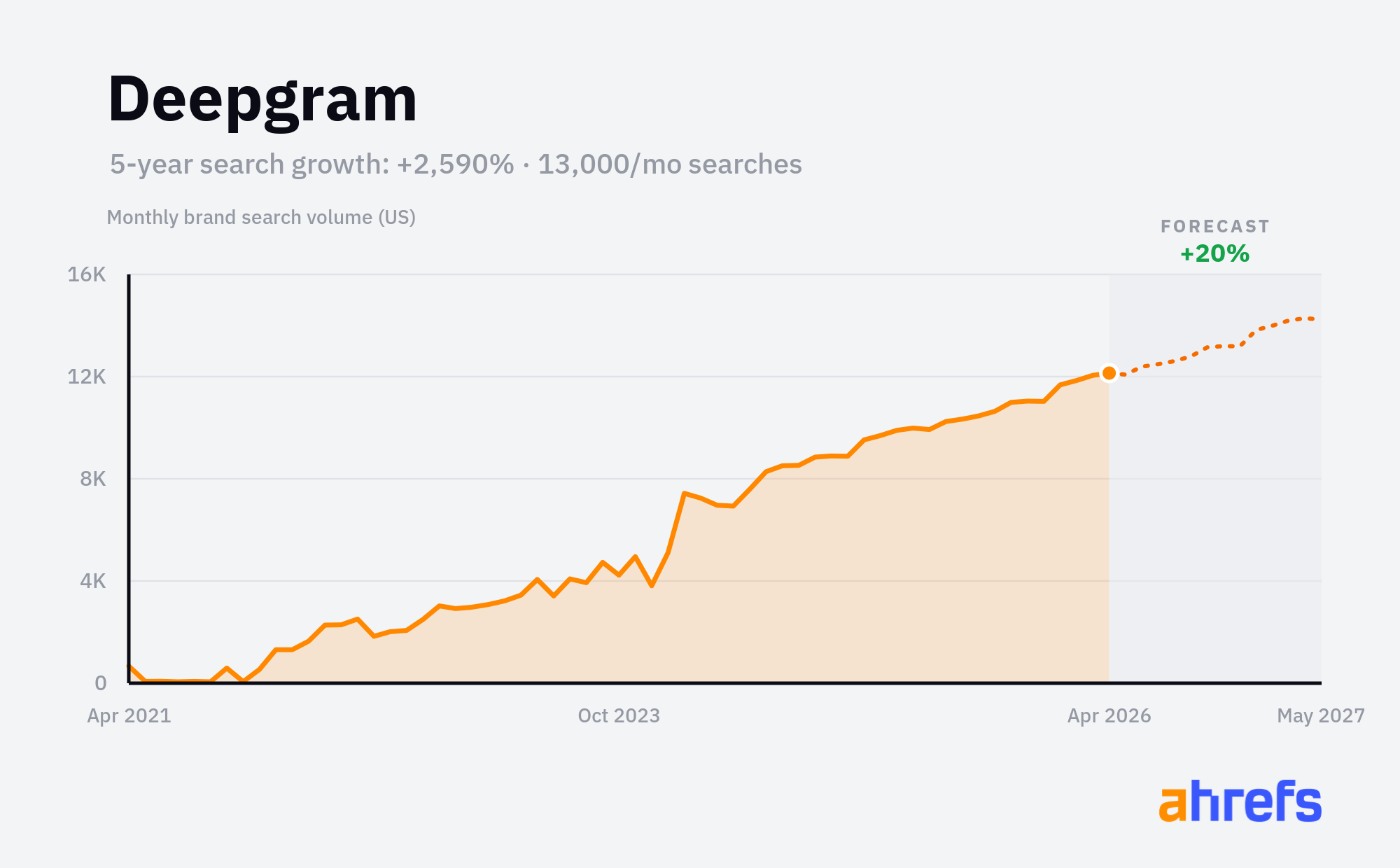
- Brand search growth (5-year): +2,590%
- 1-year search growth: +20%
- Search growth forecast: +20%
- Monthly brand searches: 13,000
- Organic traffic (monthly): 91,796
- Year founded: 2015
- Location: San Francisco, United States
What they do
Deepgram is a speech recognition and audio intelligence platform that provides fast, accurate transcription and voice AI APIs to developers building products that need to process spoken audio at scale.
Deepgram has raised over $215 million in total funding, including a $130M Series C in January 2026 led by AVP, at a $1.3 billion valuation.
Deepgram’s +2,590% growth over five years tracks the broader expansion of voice AI from a niche capability into a standard component of modern software products. As more teams started building with audio, from call analytics to voice interfaces to real-time transcription, demand for a reliable, fast API grew with them, and Deepgram’s developer-first approach put it in a strong position to capture that demand.
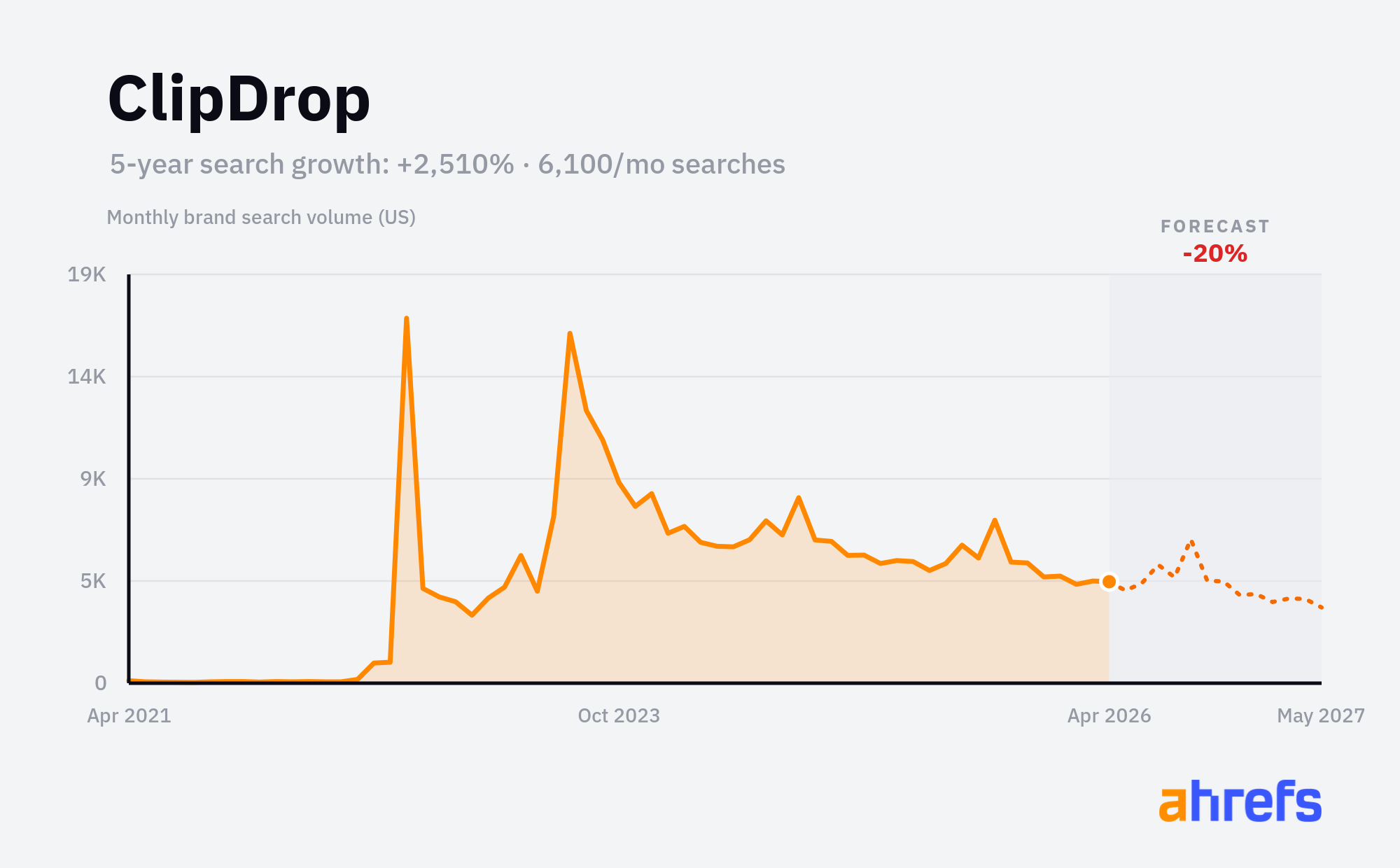
- Brand search growth (5-year): +2,510%
- 1-year search growth: -20%
- Search growth forecast: -20%
- Monthly brand searches: 6,100
- Organic traffic (monthly): 305,323
- Year founded: 2020
- Location: Paris
What they do
ClipDrop is a suite of AI-powered image editing tools, including background removal, upscaling, and generative fill, used by designers and content creators who need fast, browser-based visual editing.
ClipDrop was acquired by Stability AI in 2023, and then acquired again by Jasper in February 2024; total disclosed venture funding prior to those transactions was minimal.
The five-year brand search arc here is a product of the AI image editing wave rather than a single growth event. ClipDrop climbed fast as tools like background removal went from specialist software to something anyone expected to do in a browser. The declining 1-year trend and negative forecast reflect the competitive pressure that’s followed: the market for these tools has gotten crowded, and the ownership changes haven’t made the brand story any simpler.
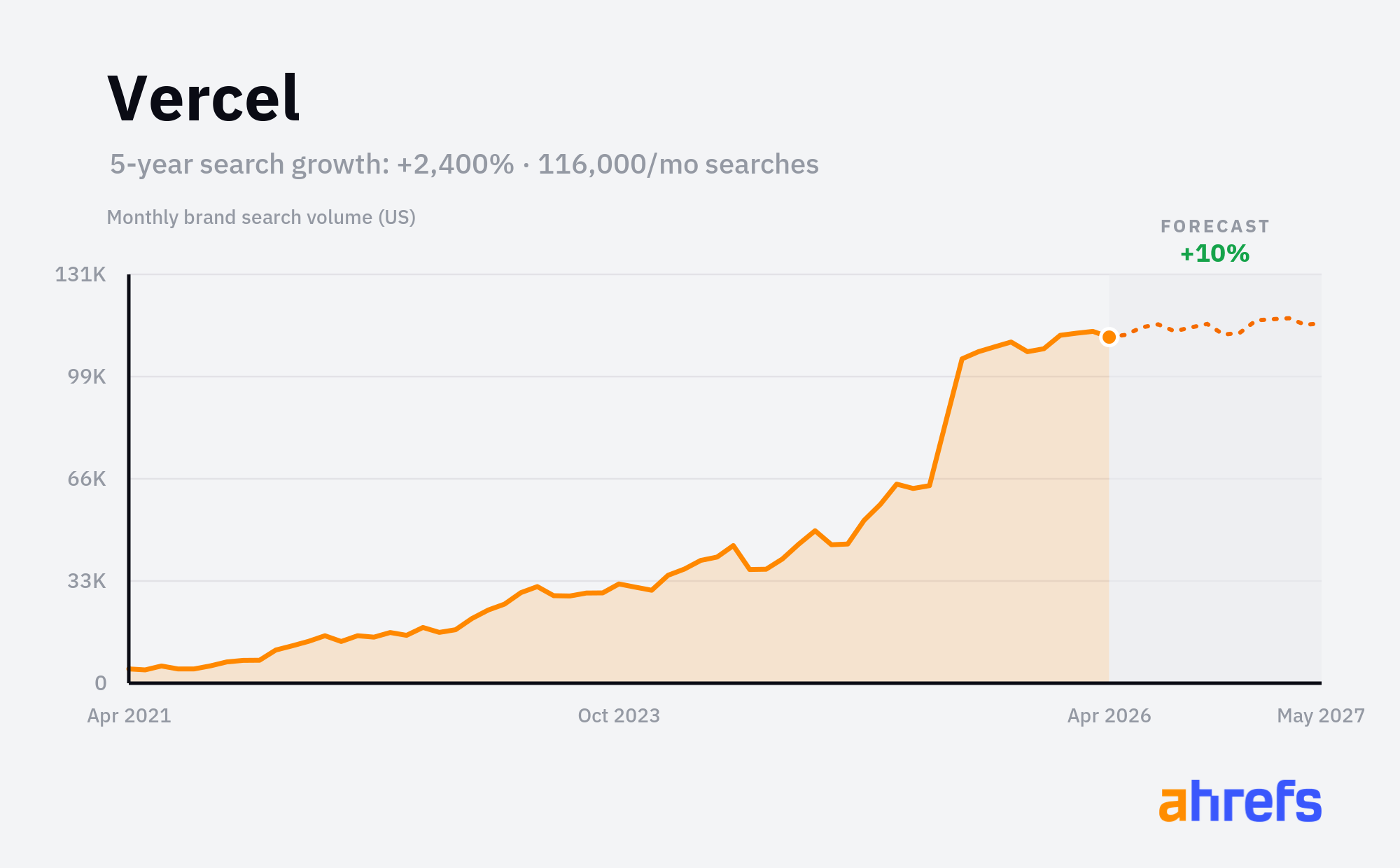
- Brand search growth (5-year): +2,400%
- 1-year search growth: +80%
- Search growth forecast: +10%
- Monthly brand searches: 116,000
- Organic traffic (monthly): 943,114
- Year founded: 2015
- Location: San Francisco, California
What they do
Vercel needs little introduction in frontend development: it’s the cloud platform for deploying and scaling web applications, closely associated with the Next.js framework and used by engineering teams at companies ranging from startups to large enterprises.
Vercel has raised $863 million in total funding, most recently a $300M Series F in September 2025 co-led by Accel and GIC at a $9.3 billion valuation.
+2,400% five-year brand search growth and ~120K monthly searches make Vercel one of the most searched developer brands on this list. Its growth is tied directly to the mainstreaming of React and Next.js as the default frontend stack, and to a developer experience that made deployment simple enough that teams stopped thinking about it as infrastructure and started treating it as a given.
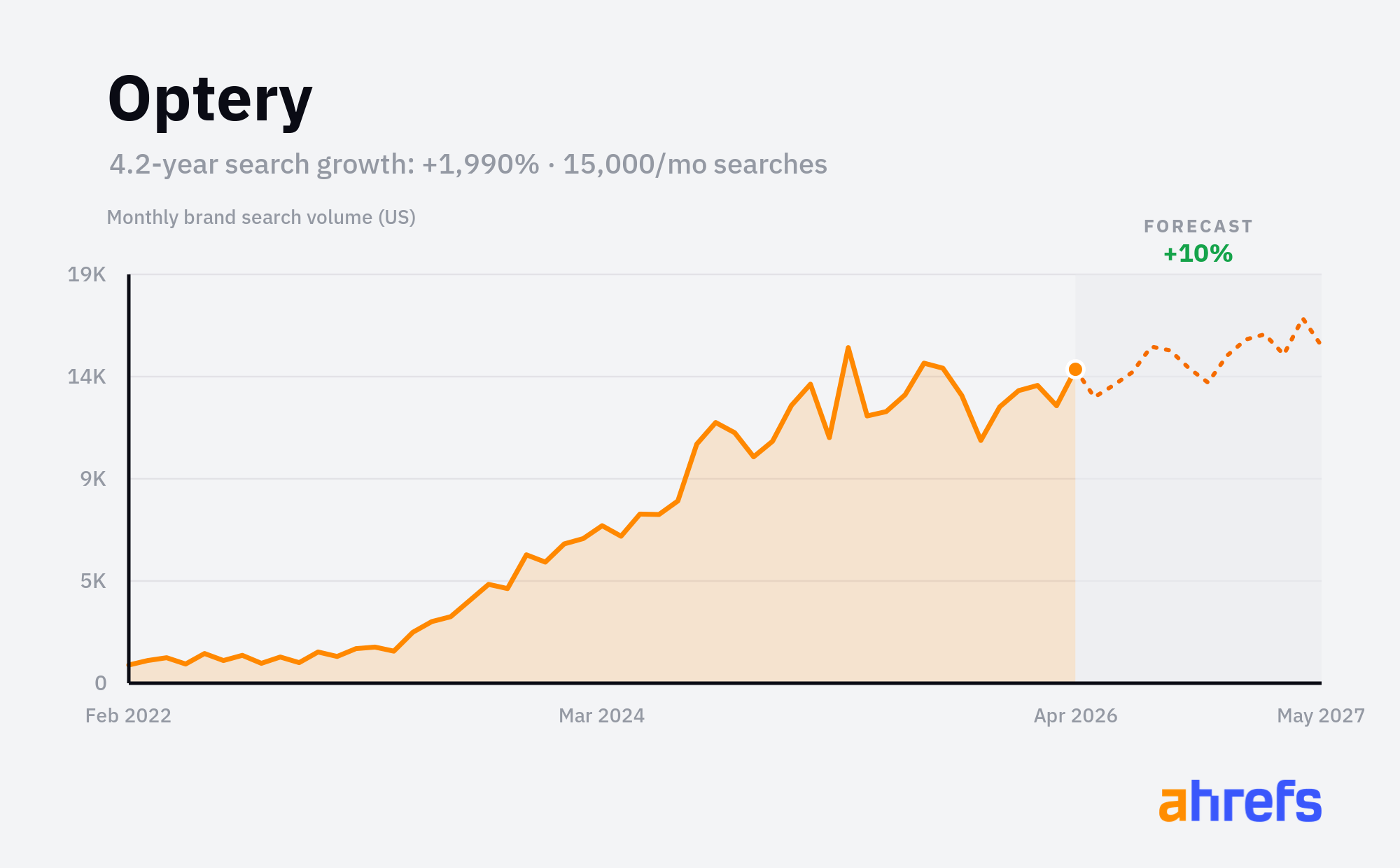
- Brand search growth (4.2-year): +1,990%
- 1-year search growth: +0%
- Search growth forecast: +10%
- Monthly brand searches: 15,000
- Organic traffic (monthly): 31,590
- Year founded: 2020
- Location: San Francisco
What they do
Optery is a personal data removal service that scans data broker websites for users’ personal information and automates the process of submitting opt-out requests, available to both individuals and businesses.
Optery has raised $6 million in total disclosed funding, most recently a $2.7M seed round in May 2023 led by Bayhouse Capital, with participation from Y Combinator, Global Founders Capital, and Goodwater Capital.
Consumer awareness of data brokers has grown steadily as high-profile privacy incidents have kept the topic in the news, and Optery has built its brand on the back of that anxiety. +1,990% growth over roughly five years from a relatively modest funding base is a decent signal that the product is doing most of the work here. The flat 1-year trend suggests growth has stabilized, but the forecast points to continued slow expansion as privacy regulation pushes more people to look for solutions like this.
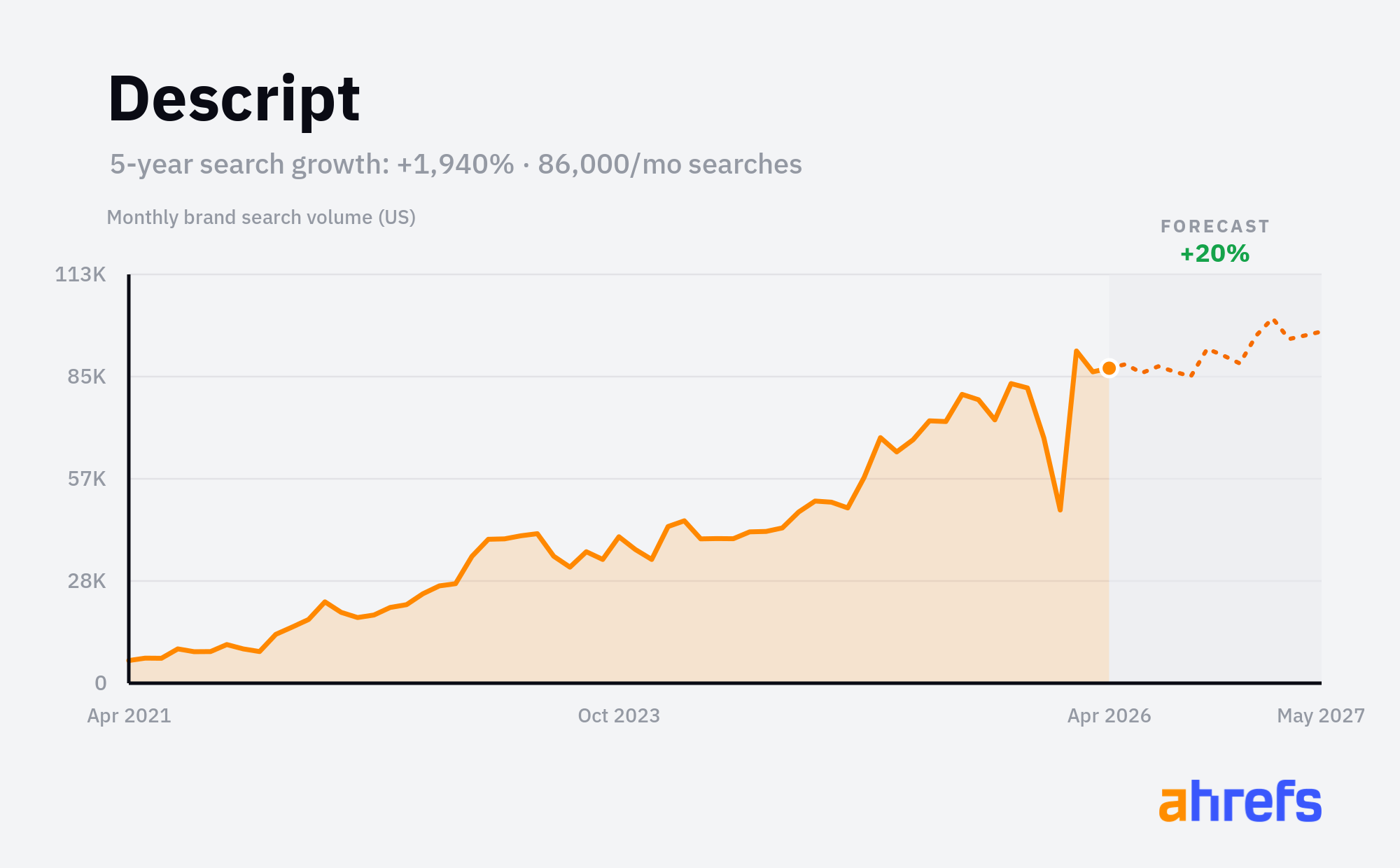
- Brand search growth (5-year): +1,940%
- 1-year search growth: +30%
- Search growth forecast: +20%
- Monthly brand searches: 86,000
- Organic traffic (monthly): 259,417
- Year founded: 2017
- Location: San Francisco, CA
What they do
Descript is a video and podcast editing platform that lets creators edit audio and video by editing the transcript text, along with AI-powered features like voice cloning, filler word removal, and screen recording.
Descript has raised $100 million in total funding, including a $50M Series C in November 2022 led by the OpenAI Startup Fund, with participation from Andreessen Horowitz and Redpoint Ventures.
Video editing used to require either professional skills or a painful learning curve, and Descript’s core insight was that most people already know how to edit text. That framing unlocked a huge audience of podcasters, YouTubers, and marketers who wanted to produce polished video without spending hours in a timeline. ~90K monthly brand searches and +1,940% five-year growth suggest that audience is still finding its way to the product.
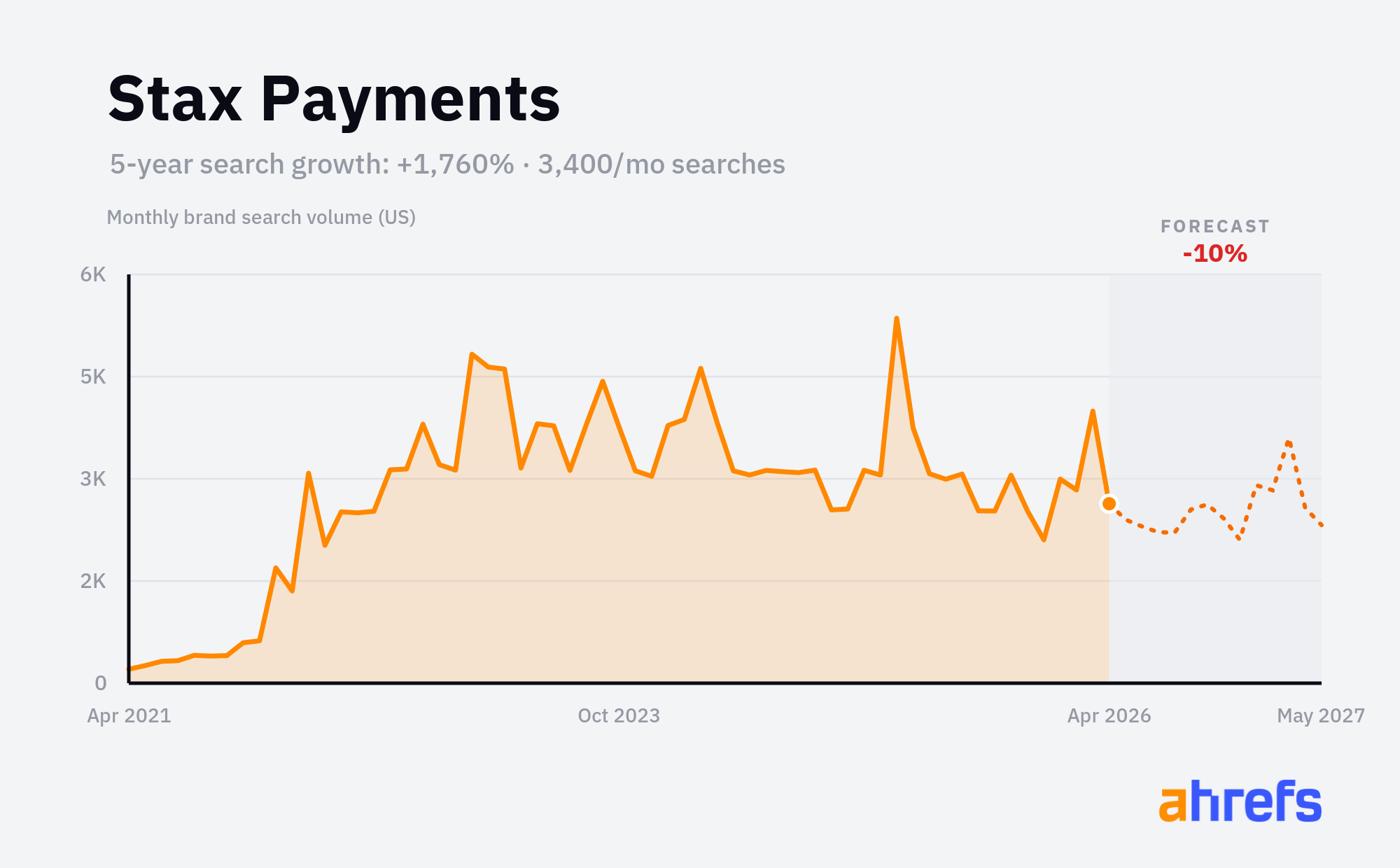
- Brand search growth (5-year): +1,760%
- 1-year search growth: -20%
- Search growth forecast: -10%
- Monthly brand searches: 3,400
- Organic traffic (monthly): 13,242
- Year founded: 2014
- Location: Orlando, Florida
What they do
Stax Payments is a payments technology company that provides integrated payment processing, recurring billing, and payment infrastructure to software platforms and small and medium-sized businesses.
Stax has raised approximately $264 million in total funding, including a $245M Series D in March 2022 led by Greater Sum Ventures, HarbourVest Partners, and Blue Star Innovation Partners, which pushed the company past a $1 billion valuation.
Stax’s +1,760% five-year brand growth reflects its expansion from a subscription-model payment processor for SMBs into a broader integrated payments platform, an evolution that brought new customers and new use cases through the early part of this decade. The declining 1-year trend and negative forecast suggest the brand awareness built during that high-growth period is now plateauing, which is fairly typical for payments infrastructure companies once they’ve established their market position.
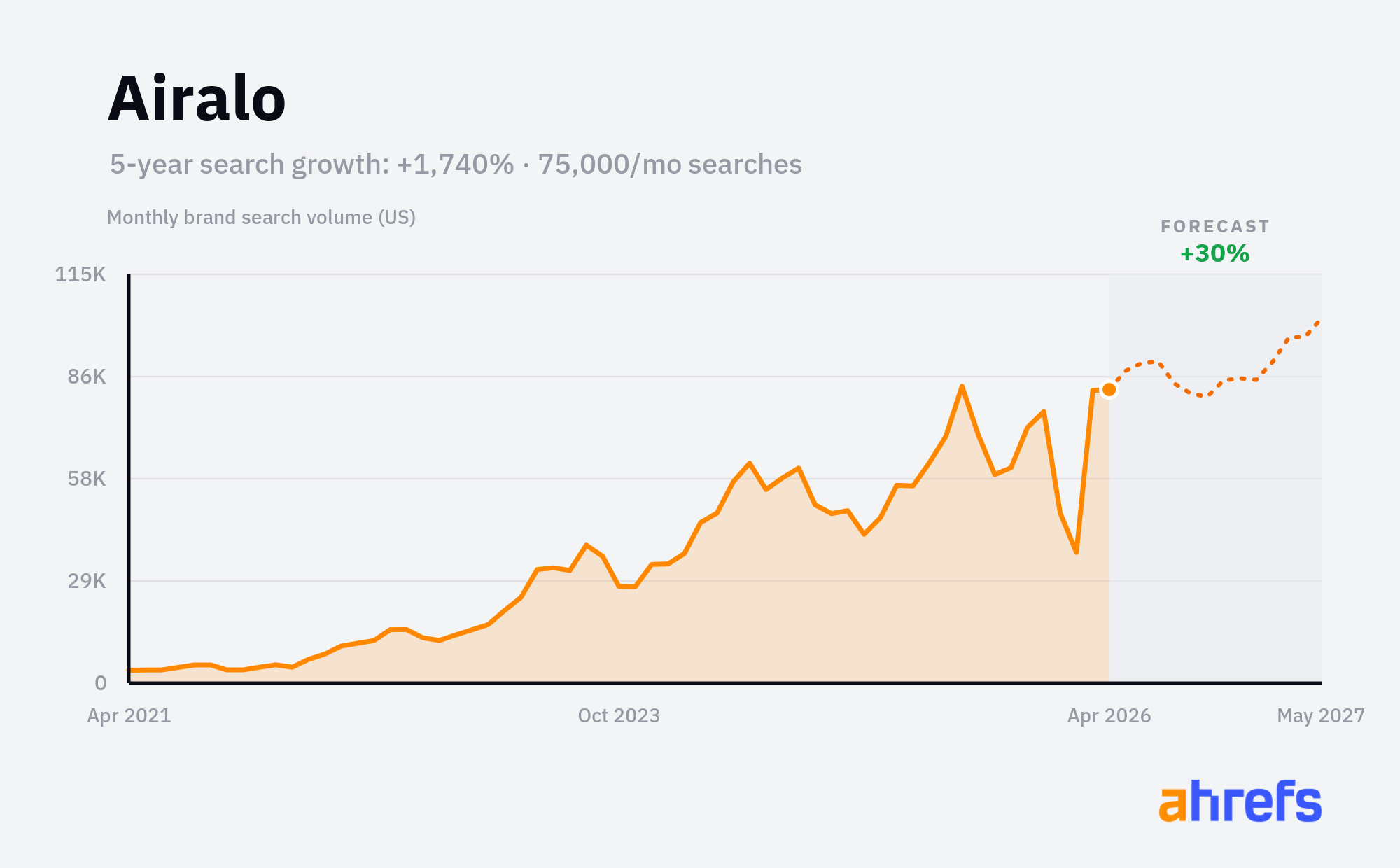
- Brand search growth (5-year): +1,740%
- 1-year search growth: +20%
- Search growth forecast: +30%
- Monthly brand searches: 75,000
- Organic traffic (monthly): 1,580,571
- Year founded: 2019
- Location: Singapore, Singapore
What they do
Airalo is a marketplace for eSIM data plans that lets travelers buy local or regional mobile data for over 200 countries and territories before or during a trip, entirely through an app without needing a physical SIM card.
Airalo has raised $285.4 million in total funding, including a $220 million venture round in 2025 led by CVC, with participation from Peak XV and Antler Elevate.
eSIM adoption has been one of the quieter technology shifts of the past several years, accelerating as Apple and Android handsets have made it a standard feature. Airalo caught that wave early and built a brand that international travelers now reach for by name. ~80K monthly brand searches and a +30% forward forecast suggest this one still has room to run as eSIM becomes the default way people handle data when they travel.
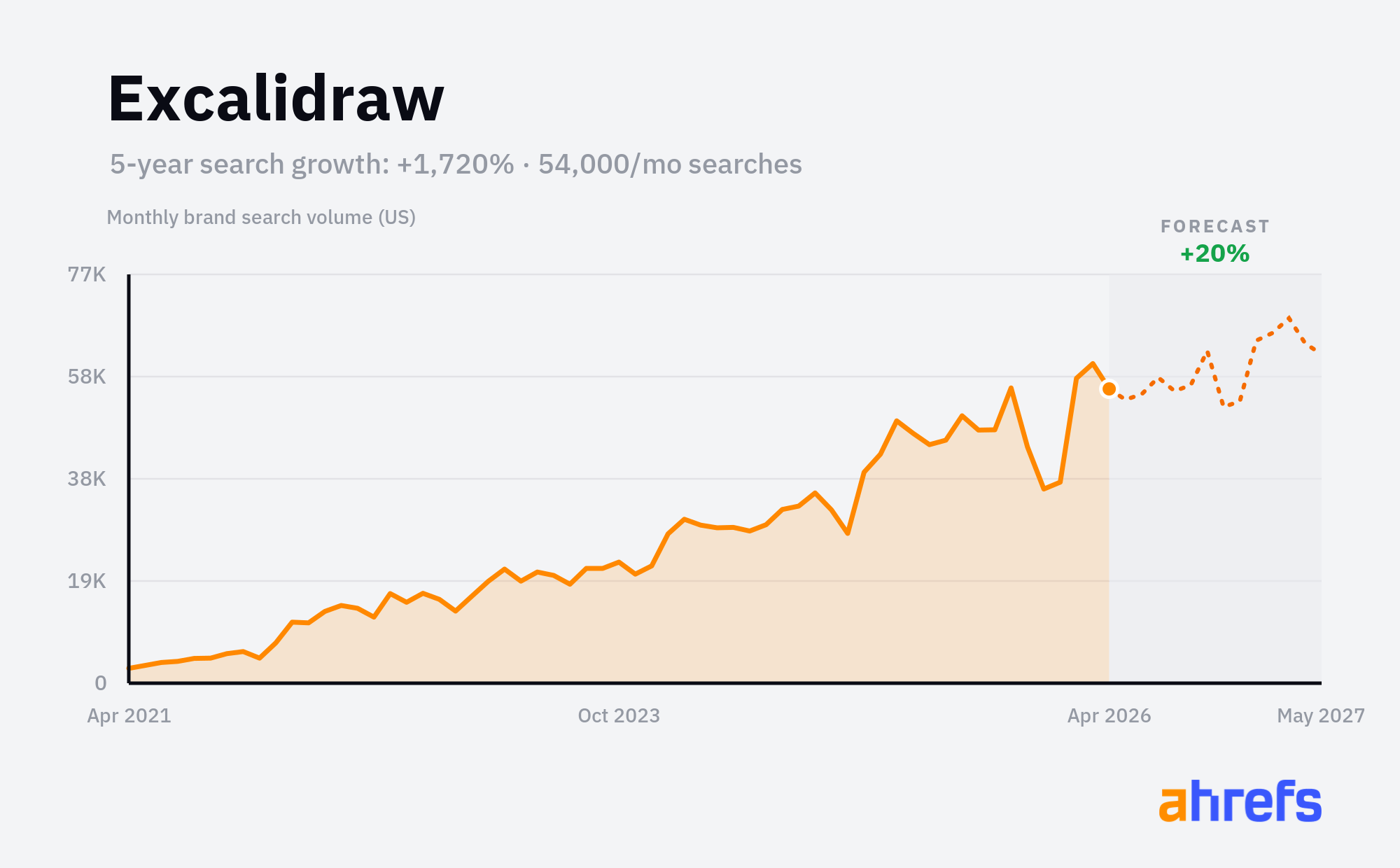
- Brand search growth (5-year): +1,720%
- 1-year search growth: +20%
- Search growth forecast: +20%
- Monthly brand searches: 54,000
- Organic traffic (monthly): 54,026
- Year founded: 2020
- Location: Brno, South Moravia
What they do
Excalidraw is an open-source virtual whiteboard tool that lets users quickly sketch diagrams and wireframes with a characteristic hand-drawn aesthetic, used widely by developers, designers, and product teams for visual thinking.
Excalidraw is bootstrapped and has raised no venture funding.
~50K monthly brand searches and +1,720% five-year growth without a dollar of outside funding is a useful reminder that organic demand can be built without a marketing budget. Excalidraw spread almost entirely through word of mouth in developer and design communities, where its simple, approachable look and open-source nature made it easy to share and embed. Consistent +20% growth in both the past year and the forward forecast suggests it’s found a durable place in the collaboration tool stack.
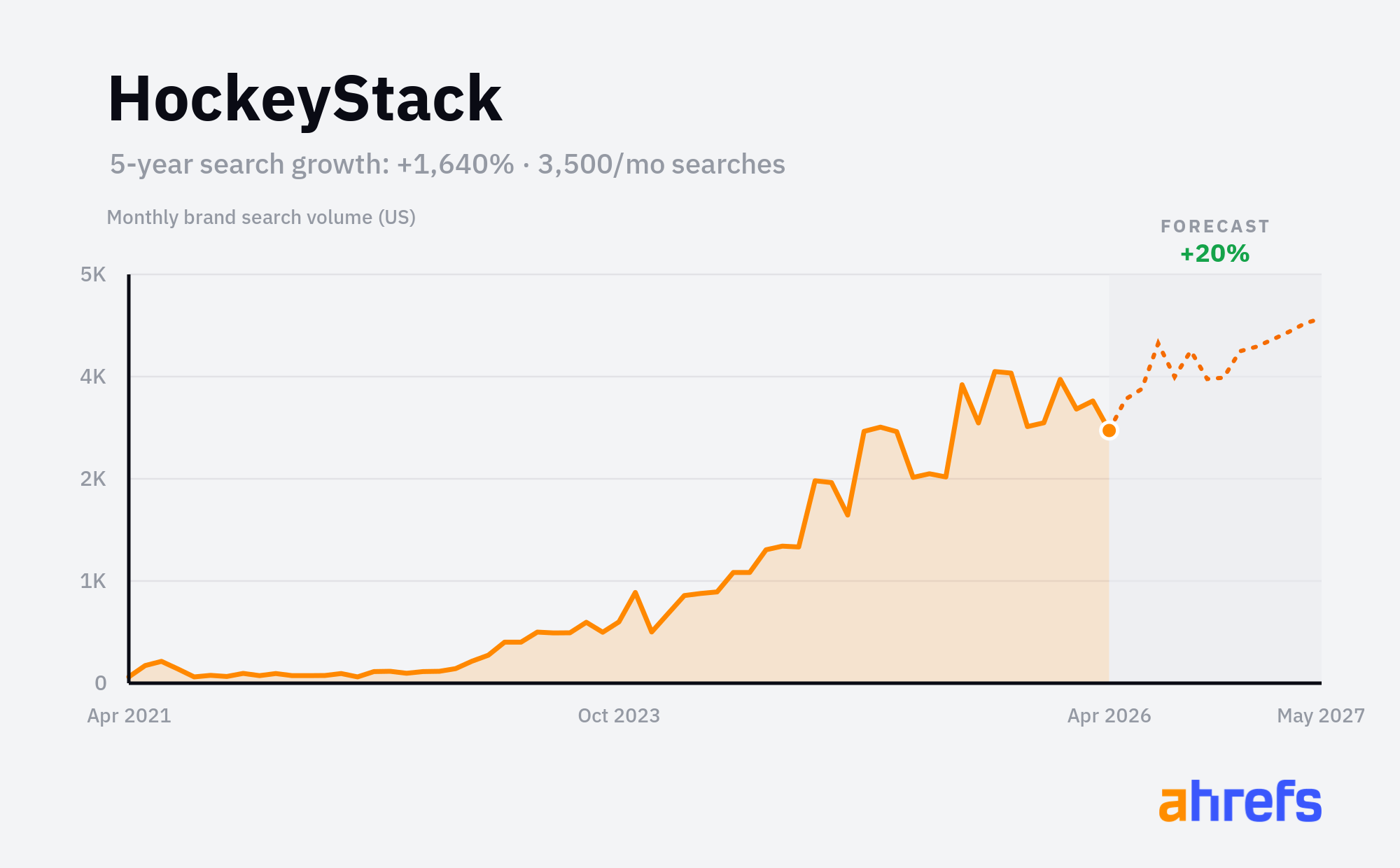
- Brand search growth (5-year): +1,640%
- 1-year search growth: +20%
- Search growth forecast: +20%
- Monthly brand searches: 3,500
- Organic traffic (monthly): 11,736
- Year founded: 2021
- Location: San Francisco, California
What they do
HockeyStack is a B2B revenue analytics platform that helps marketing and sales teams understand the full buyer journey, attribute pipeline to specific channels and touchpoints, and make budget decisions based on unified account-level data.
HockeyStack has raised over $50 million in total funding, including a $50M round in April 2026 with contributions from Bessemer Venture Partners, Y Combinator, and Uncorrelated Ventures, on top of a $20M Series A led by Bessemer in January 2025.
B2B attribution has been a genuinely hard problem for a long time, and HockeyStack has built a following among marketing teams who’ve grown frustrated with single-touch models and fragmented data. +1,640% five-year growth from a relatively small brand search base reflects a product earning real loyalty in a specific and demanding audience, and the fresh April 2026 funding suggests investors see more runway ahead.
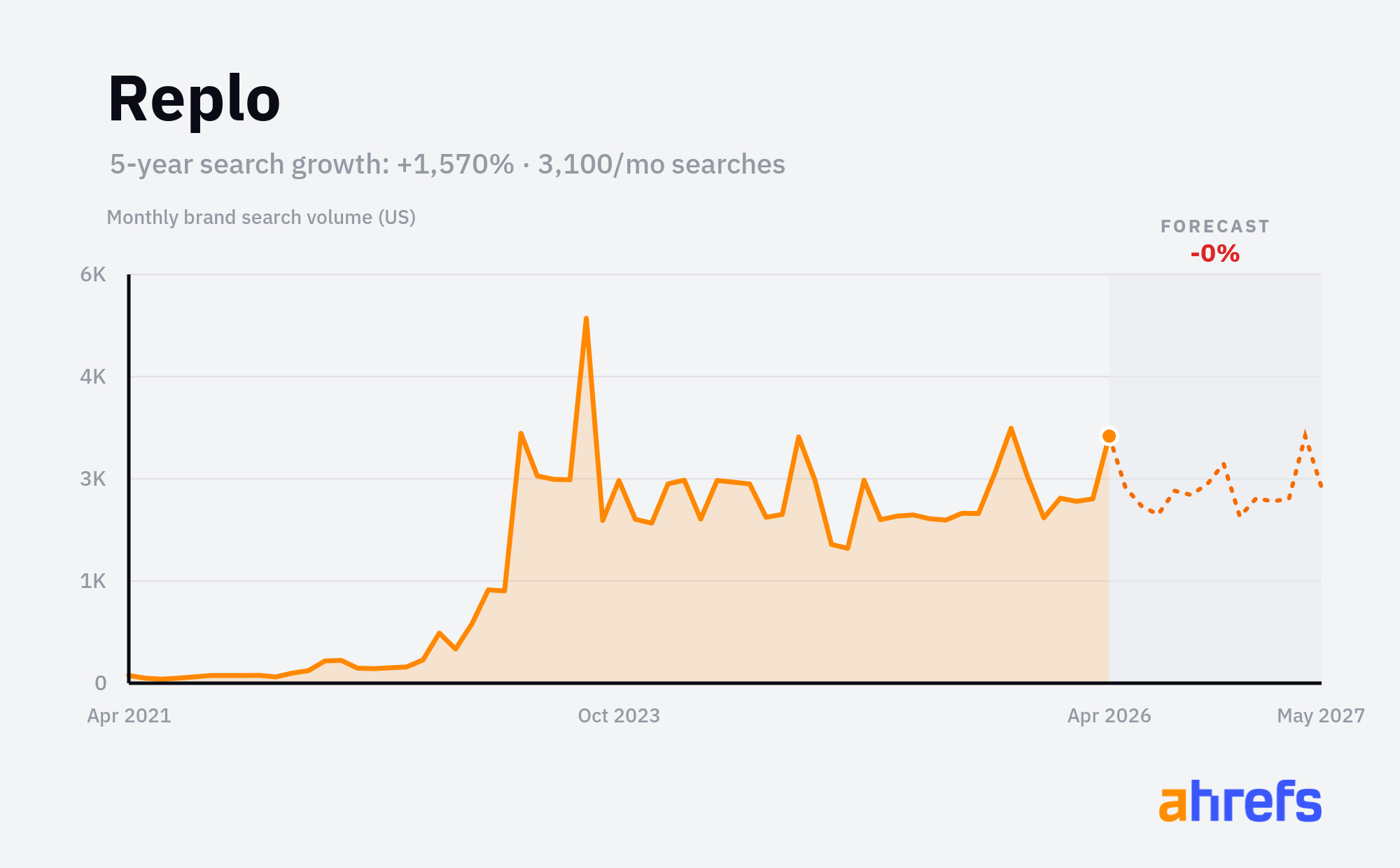
- Brand search growth (5-year): +1,570%
- 1-year search growth: +20%
- Search growth forecast: -0%
- Monthly brand searches: 3,100
- Organic traffic (monthly): 11,512
- Year founded: 2021
- Location: San Francisco, California
What they do
Replo is a page-building platform for Shopify brands that lets e-commerce teams design and publish high-performance landing pages and storefront sections without relying on developer bandwidth.
Replo raised a $4.2M seed round in February 2023, with backing from Y Combinator, Infinity Ventures, Figma Ventures, and Guillermo Rauch of Vercel, among others.
The Shopify ecosystem has grown large enough that tools built specifically for it can develop real, self-contained audiences, and that’s the dynamic behind Replo’s +1,570% five-year growth. E-commerce teams that rely on conversion-optimized landing pages have been a willing audience for a purpose-built Shopify tool, particularly one that reduces the back-and-forth with developers that slows campaigns down.
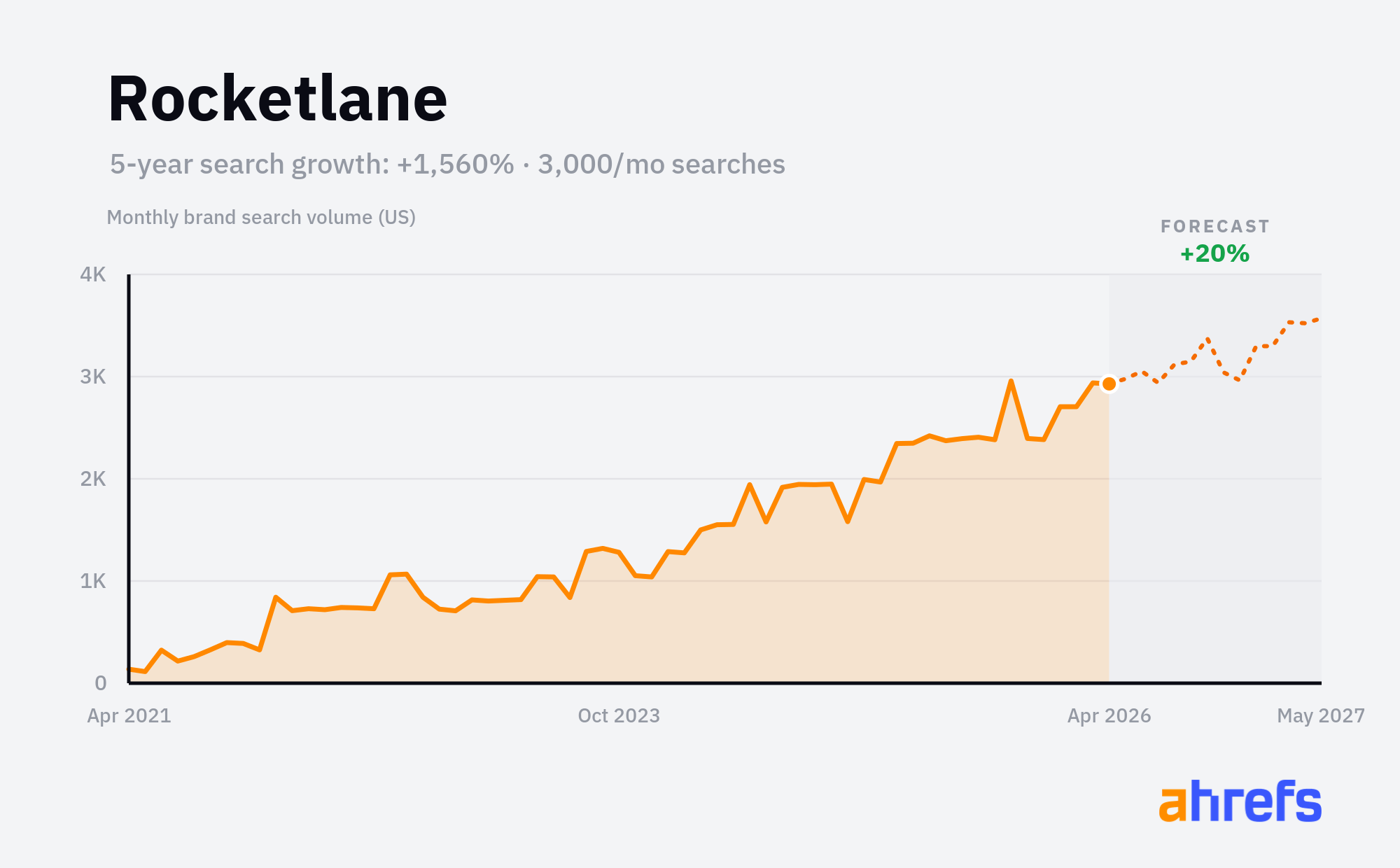
- Brand search growth (5-year): +1,560%
- 1-year search growth: +20%
- Search growth forecast: +20%
- Monthly brand searches: 3,000
- Organic traffic (monthly): 17,500
- Year founded: 2020
- Location: Walnut, California
What they do
Rocketlane is a customer onboarding and professional services automation platform that helps SaaS companies manage implementation projects, collaborate with customers, and track the time, resources, and financials involved in delivering services.
Rocketlane has raised $105 million in total funding, most recently a $60M Series C in March 2026 led by Insight Partners.
Customer onboarding is one of those categories that enterprise SaaS buyers care about deeply but that doesn’t generate a lot of consumer-level buzz, which makes Rocketlane’s +1,560% five-year brand growth more impressive in context. The platform has earned its audience by addressing a real operational pain: the gap between closing a deal and delivering value to a new customer, which has historically been managed through spreadsheets and email threads.
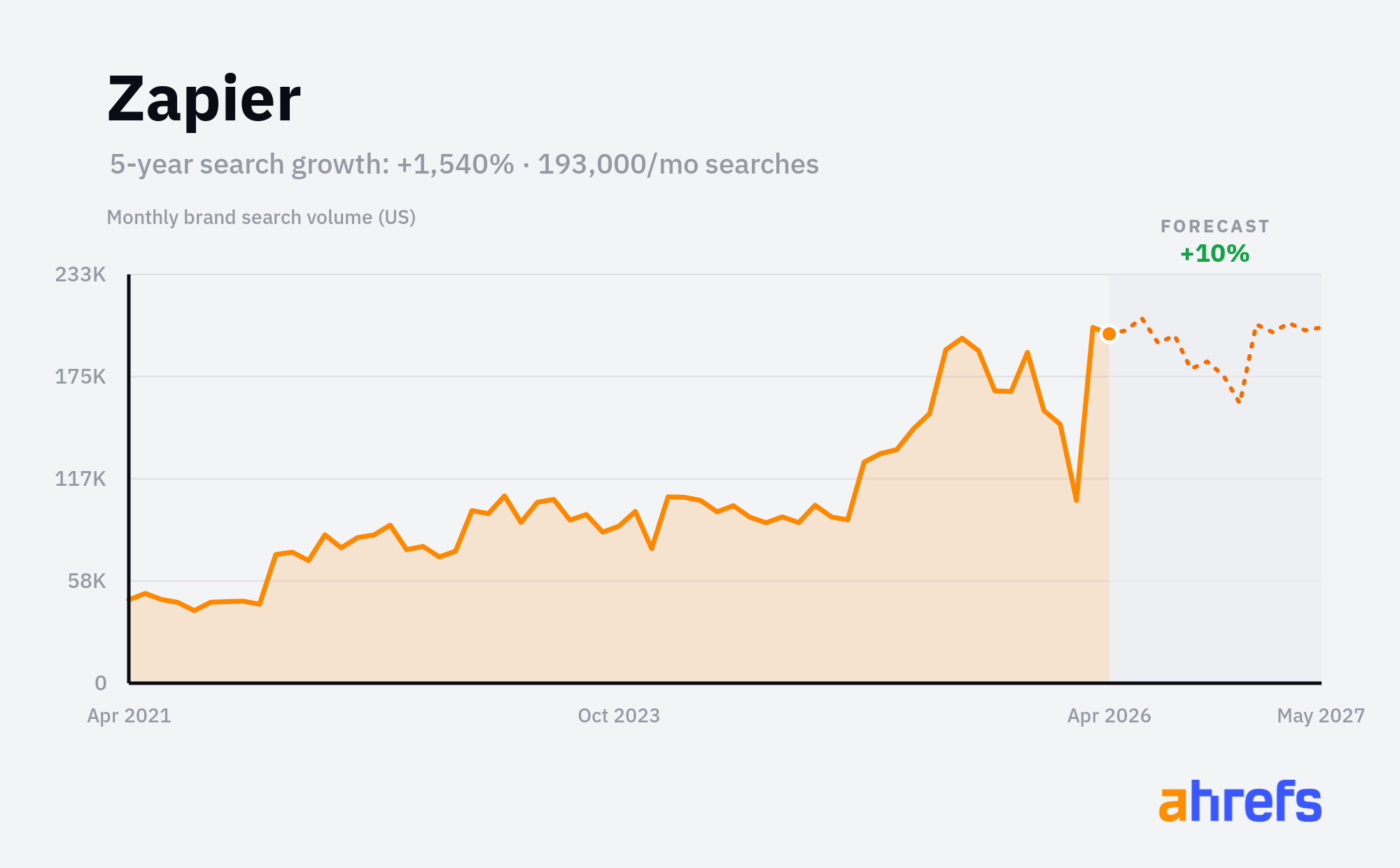
- Brand search growth (5-year): +1,540%
- 1-year search growth: +20%
- Search growth forecast: +10%
- Monthly brand searches: 193,000
- Organic traffic (monthly): 4,497,918
- Year founded: 2011
- Location: San Francisco, CA
What they do
Zapier needs little introduction: it’s the workflow automation platform that connects thousands of apps and lets non-technical users build automated processes without writing code, used by teams across virtually every industry.
Zapier raised $1.3 million in seed funding in 2012, backed by Y Combinator and Bessemer Venture Partners, and has operated without further outside funding since.
+1,540% five-year brand search growth and ~190K monthly searches is remarkable for a company that raised just $1.3M and has been operating for over a decade. Zapier’s continued growth reflects two things: the sustained expansion of the no-code automation category, and a brand that’s genuinely become a verb in the way people describe connecting software tools together. Among the fastest growing companies on this list, it’s the most established, and it’s still moving.
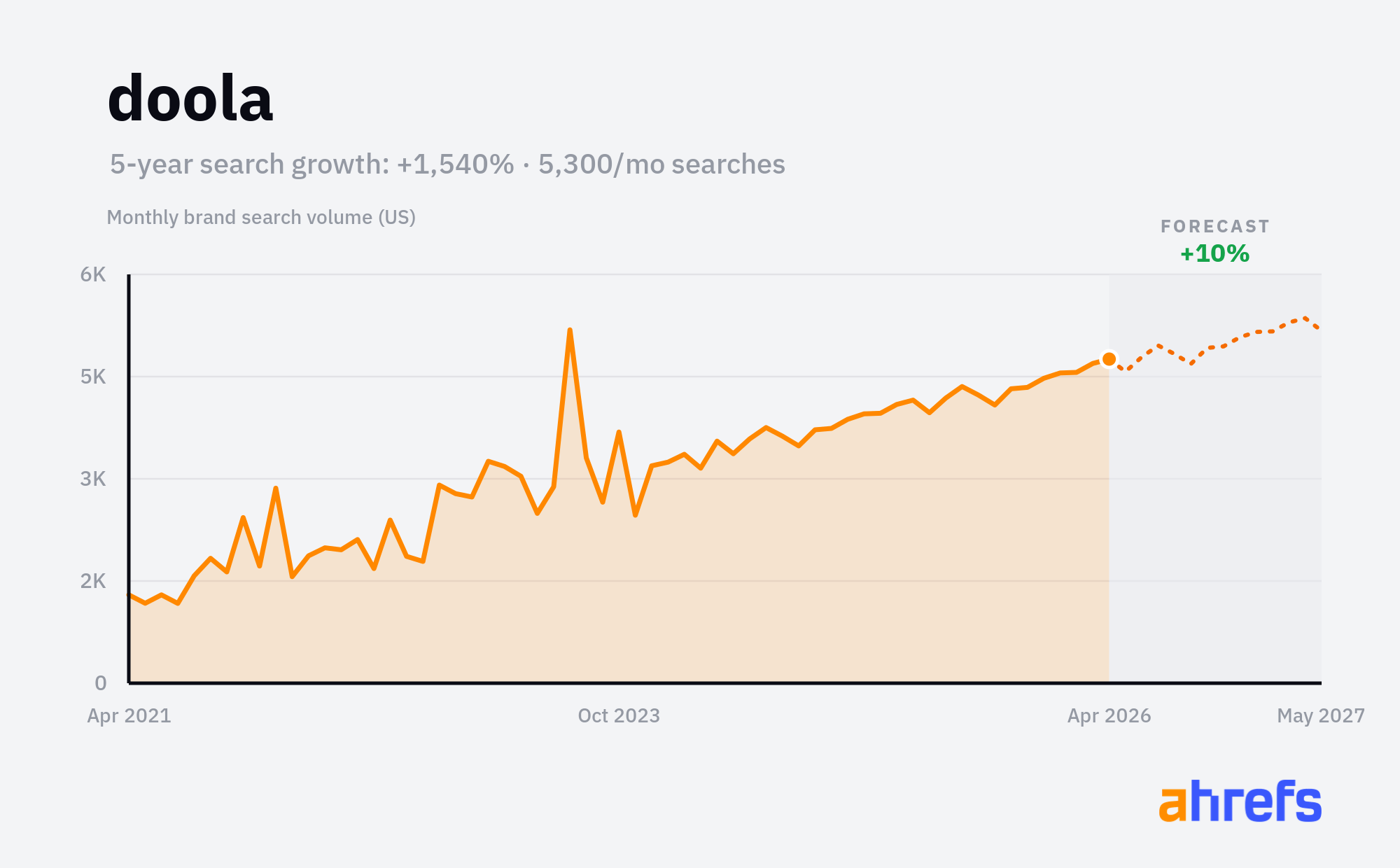
- Brand search growth (5-year): +1,540%
- 1-year search growth: +20%
- Search growth forecast: +10%
- Monthly brand searches: 5,300
- Organic traffic (monthly): 10,803
- Year founded: 2020
- Location: New York, NY
What they do
doola is a business formation and compliance platform that helps international entrepreneurs set up a US LLC, open a US bank account, and handle ongoing tax and compliance requirements, all remotely.
doola has raised $13 million in total disclosed venture funding, including a $8M Series A led by Nexus Venture Partners and a subsequent strategic investment from HubSpot Ventures.
The global freelancer and founder economy has created a real, growing demand for a simple way to get a US business entity up and running remotely. doola’s +1,540% five-year growth reflects a product that found that audience early and has grown with it as more international entrepreneurs treat a US LLC as a standard step in setting up an online business.
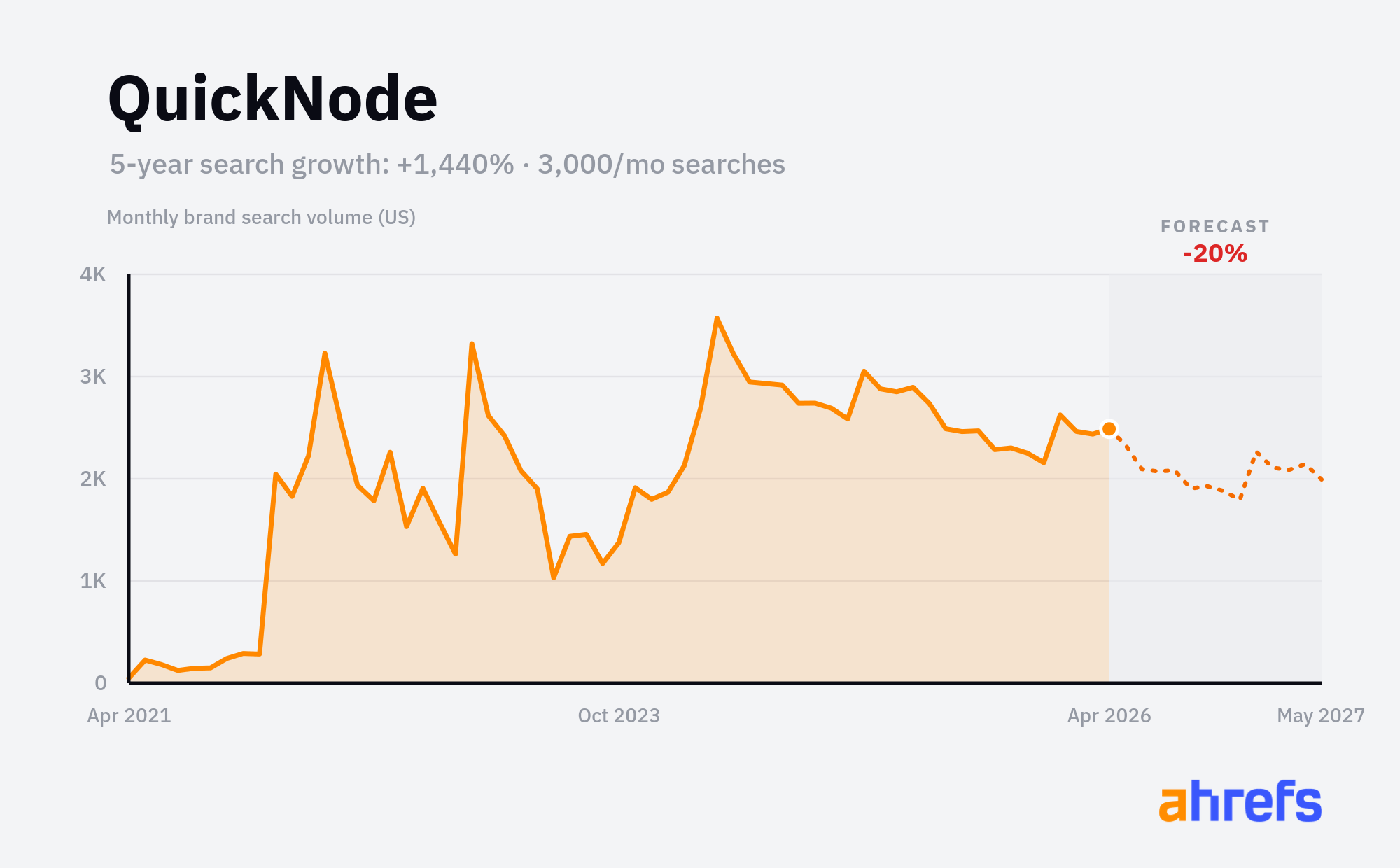
- Brand search growth (5-year): +1,440%
- 1-year search growth: -10%
- Search growth forecast: -20%
- Monthly brand searches: 3,000
- Organic traffic (monthly): 40,001
- Year founded: 2017
- Location: Miami
What they do
QuickNode is a blockchain infrastructure platform that provides developers with fast API access to over 40 blockchains, along with developer tools for building, testing, and scaling Web3 applications.
QuickNode has raised approximately $101.9 million in total funding, including a $60M Series B in January 2023 led by 10T Holdings, with participation from Tiger Global, Seven Seven Six, and SoftBank’s SB Opportunity Fund.
QuickNode’s +1,440% five-year brand search growth tracks the expansion and partial contraction of developer interest in blockchain infrastructure, and the negative 1-year trend and forecast reflect the cooling that followed the crypto market peak. The underlying product still serves a real need for developers who are actively building on-chain, but the brand awareness built during peak cycle enthusiasm is harder to sustain when the broader market is quieter.
The full 50: fastest-growing SaaS companies by brand search
| # | Company | Industry | Brand search growth | Monthly brand searches |
|---|---|---|---|---|
| 1 |  Metricool Metricool | Marketing | +17,780% (5-year) | 32,000 |
| 2 | Supabase | Dev tools | +12,420% (5-year) | 90,000 |
| 3 | Cartpanda | E-commerce | +8,820% (2.1-year) | 17,000 |
| 4 | FlutterFlow | No-code | +8,330% (5-year) | 17,000 |
| 5 | Tailscale | Security | +7,640% (5-year) | 98,000 |
| 6 | NinjaOne | IT management | +4,000% (4.4-year) | 21,000 |
| 7 | Anthropic | AI / ML | +3,310% (3.2-year) | 258,000 |
| 8 | Roboflow | AI / ML | +3,250% (5-year) | 17,000 |
| 9 | IPQS | Security | +3,200% (5-year) | 7,400 |
| 10 | beehiiv | Marketing | +3,200% (4.4-year) | 24,000 |
| 11 | Copyleaks | AI / ML | +2,700% (5-year) | 43,000 |
| 12 | Deepgram | AI / ML | +2,590% (5-year) | 13,000 |
| 13 | ClipDrop | AI / ML | +2,510% (5-year) | 6,100 |
| 14 | Vercel | Dev tools | +2,400% (5-year) | 116,000 |
| 15 | Optery | Security | +1,990% (4.2-year) | 15,000 |
| 16 | Descript | Video | +1,940% (5-year) | 86,000 |
| 17 | Stax Payments | Fintech | +1,760% (5-year) | 3,400 |
| 18 | Airalo | Telecom | +1,740% (5-year) | 75,000 |
| 19 | Excalidraw | Productivity | +1,720% (5-year) | 54,000 |
| 20 | HockeyStack | Analytics | +1,640% (5-year) | 3,500 |
| 21 | Replo | E-commerce | +1,570% (5-year) | 3,100 |
| 22 | Rocketlane | Customer support | +1,560% (5-year) | 3,000 |
| 23 | Zapier | Productivity | +1,540% (5-year) | 193,000 |
| 24 | doola | Fintech | +1,540% (5-year) | 5,300 |
| 25 | QuickNode | Data infrastructure | +1,440% (5-year) | 3,000 |
| 26 | DocuClipper | Fintech | +1,440% (5-year) | 3,200 |
| 27 | Fyle | Fintech | +1,410% (5-year) | 6,300 |
| 28 | Gymdesk | Vertical SaaS | +1,410% (4.2-year) | 5,400 |
| 29 | Sumsub | Security | +1,410% (5-year) | 3,900 |
| 30 | Modash | Marketing | +1,310% (5-year) | 2,600 |
| 31 | Storylane | Sales / CRM | +1,310% (4.2-year) | 3,400 |
| 32 | SigNoz | Dev tools | +1,320% (5-year) | 2,500 |
| 33 | Photoroom | Design | +1,310% (5-year) | 19,000 |
| 34 | Dripos | E-commerce | +1,290% (5-year) | 2,400 |
| 35 | Planable | Marketing | +1,240% (5-year) | 5,500 |
| 36 | Instrumentl | Productivity | +1,200% (5-year) | 3,900 |
| 37 | Tavus | Video | +1,180% (3.7-year) | 3,000 |
| 38 | Coursedog | Education | +1,170% (5-year) | 5,600 |
| 39 | Panorama Education | Education | +1,160% (5-year) | 9,800 |
| 40 | Eldorado.gg | E-commerce | +1,150% (5-year) | 8,600 |
| 41 | Zeelo | Vertical SaaS | +1,120% (5-year) | 3,100 |
| 42 | RevenueCat | Dev tools | +1,030% (5-year) | 6,100 |
| 43 | Appcues | Product analytics | +1,010% (5-year) | 4,100 |
| 44 | Human Interest | HR | +980% (5-year) | 29,000 |
| 45 | 360Learning | Education | +980% (5-year) | 3,900 |
| 46 | Manychat | Marketing | +950% (5-year) | 70,000 |
| 47 | Metabase | Analytics | +950% (5-year) | 12,000 |
| 48 | Cradlewise | Consumer tech | +930% (5-year) | 11,000 |
| 49 | Laylo | Sales / CRM | +930% (5-year) | 3,400 |
| 50 | IPinfo | Data infrastructure | +920% (5-year) | 20,000 |
Brand search growth = growth in monthly searches for the company name, measured over five years (or the company’s full history if younger, shown in brackets). Monthly brand searches = current US search volume for the brand name. Data: Ahrefs · June 2026.
You can rebuild this entire analysis yourself in Ahrefs. Here’s the short version:
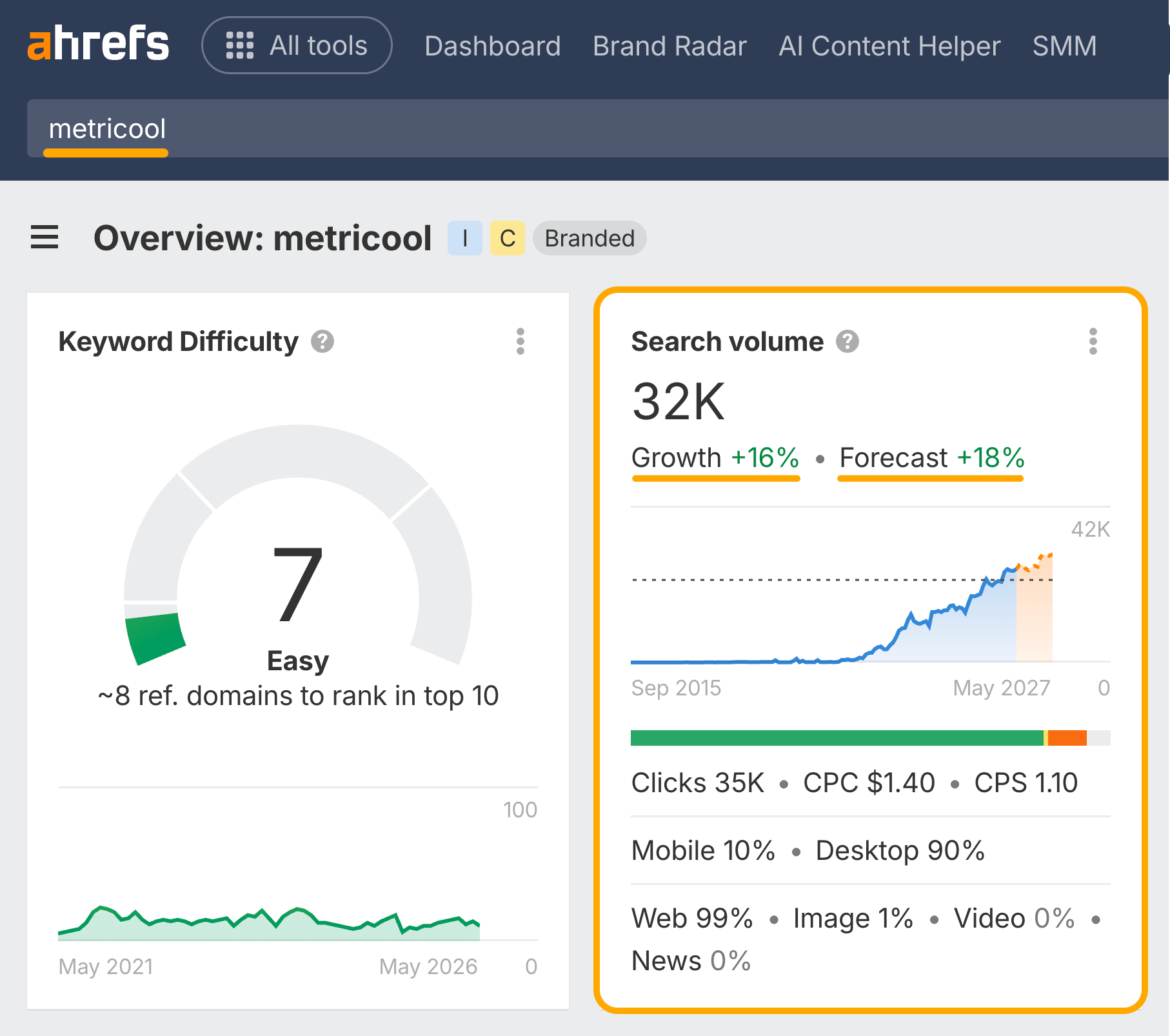
- Open Keywords Explorer, enter a company’s brand name as the keyword, and look at the volume graph. The trend over the last few years is the brand-search growth we ranked on, and the forecast line is Ahrefs’ projection.
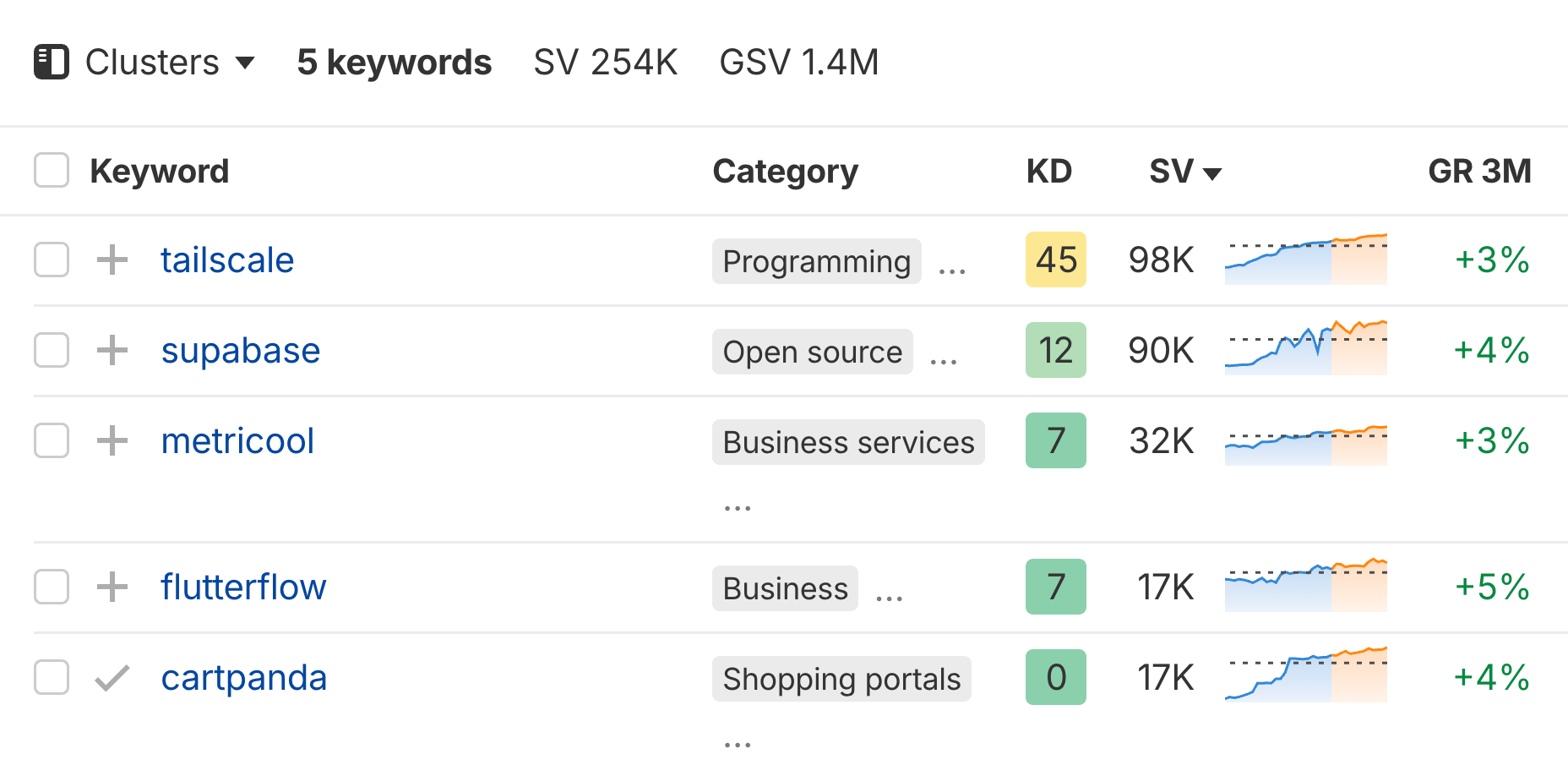
- To compare many companies at once, drop a list of brand names into Keywords Explorer and sort by volume or by growth to see which names are climbing fastest.
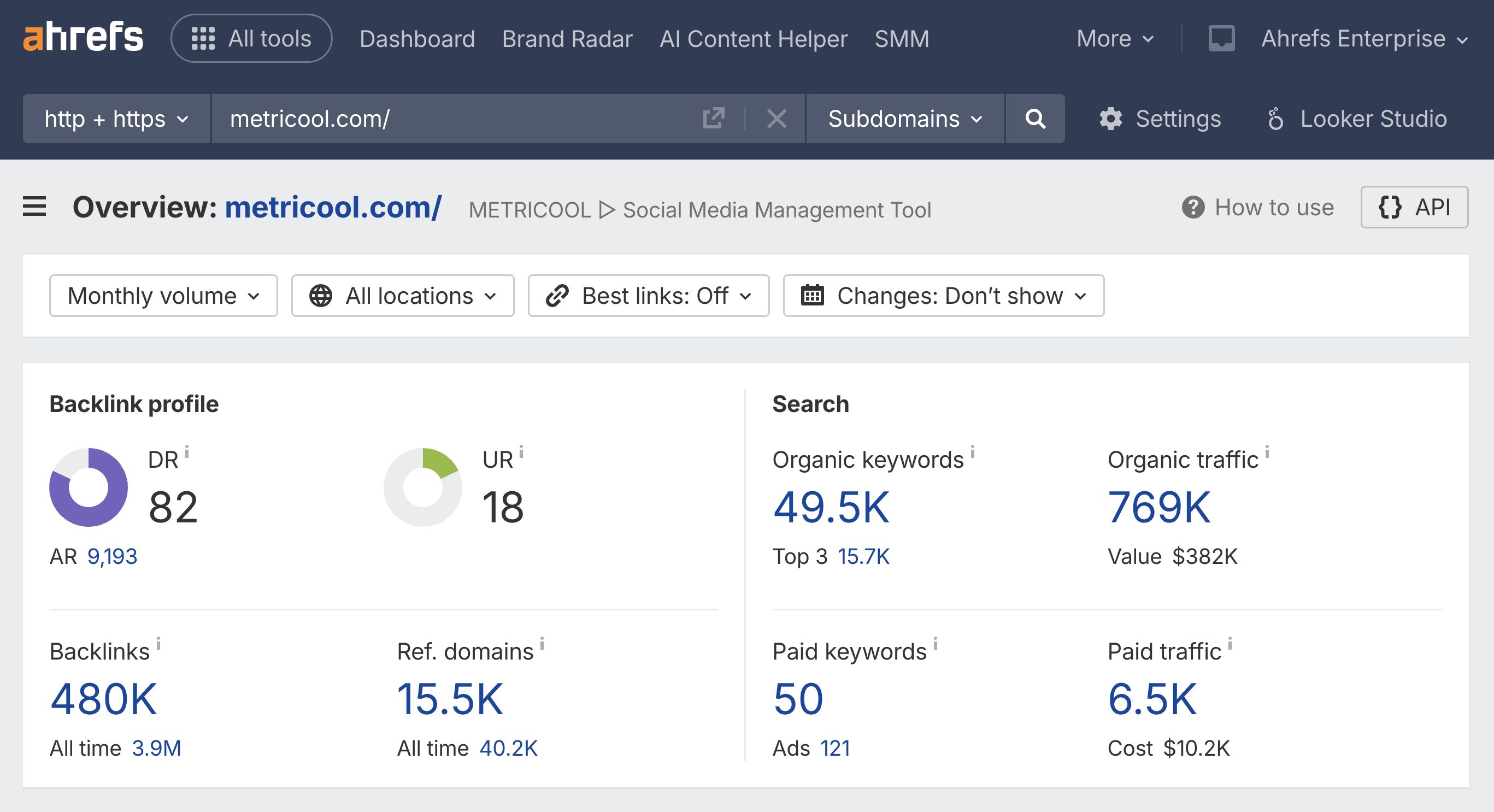
- Use Site Explorer on each company’s domain to pull the Organic traffic, Referring domains, and other figures in the profiles above.
- Or skip the manual work and let Agent A run the whole pull, filtering, and ranking for any niche you choose, the same way it built this list.
What stands out across this list of fastest growing SaaS companies is how varied the categories are: social media management, developer infrastructure, fraud detection, newsletter publishing, whiteboard tools, and e-commerce page builders all appear here, which is a useful reminder that search demand growth isn’t a category-specific phenomenon.
The common thread is products that earned their audiences through genuine utility rather than paid acquisition, many of them growing their brand searches steadily over years before anyone was paying attention.
If you’re watching where real software demand is forming, these are the companies worth keeping an eye on.