
Internal links are one of the most underused SEO levers. In this guide, I’ll show you how they work, how to structure them, and how to use them strategically to move rankings.
Internal links are hyperlinks that take visitors from one page to another on the same website. Their main purpose is to help visitors navigate your site, but they also play a significant role in SEO.
Here’s a simplified view of what an internal link looks like:
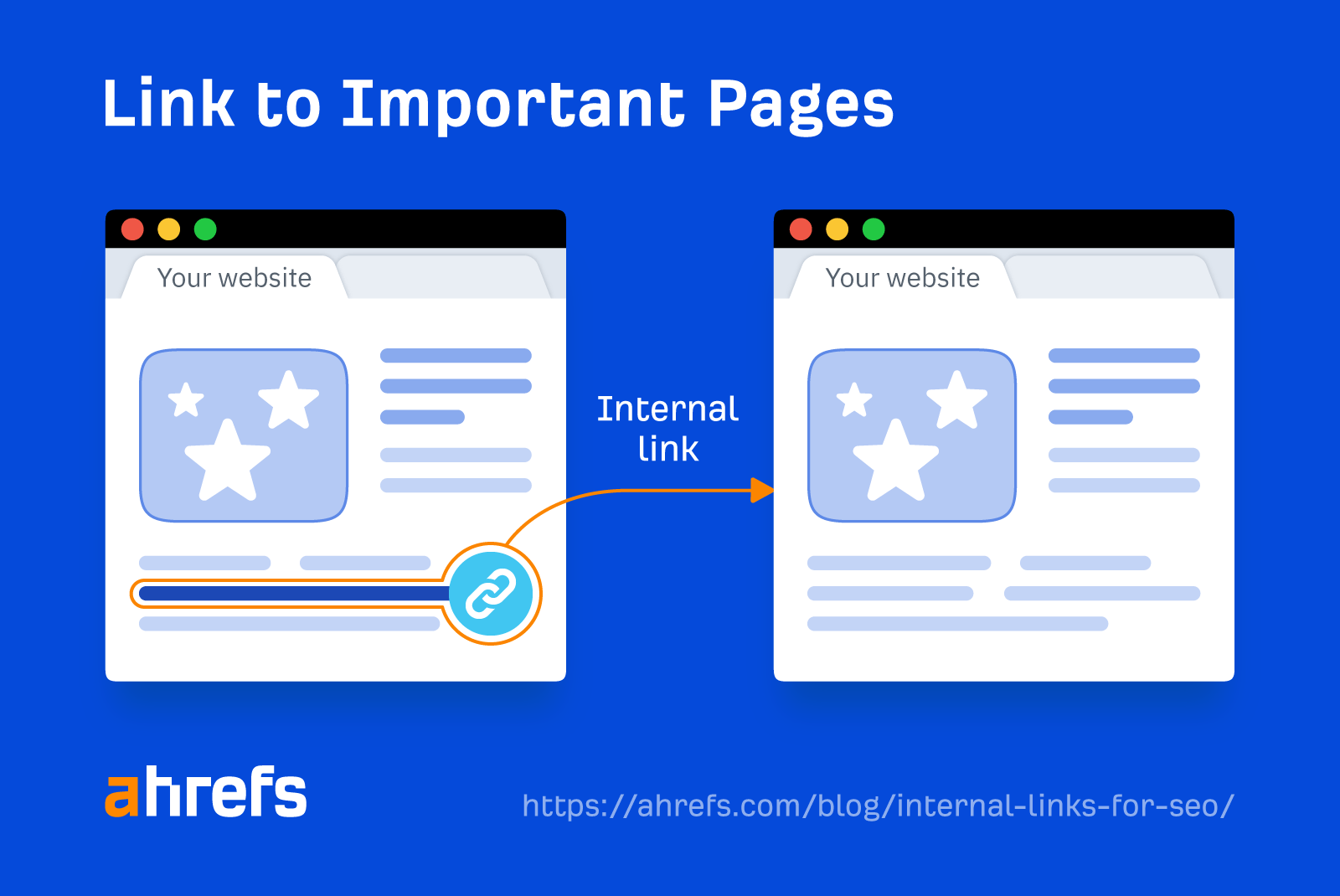
And here’s what an internal link looks like in HTML code:
<a href="https://example.com/">Internal Linking</a>
Internal links are important for SEO because they help search engines discover your pages, understand what each page is about, and distribute ranking authority (PageRank) across your site. Without them, search engines struggle to crawl and rank your content effectively.
Beyond that practical purpose of getting visitors from A to B, internal links have a strategic role in how search engines understand and rank your site.
When asked in a “Google SEO office-hours” video whether internal linking was still important for SEO, John Mueller said:
Yes, absolutely… Internal linking is super critical for SEO. It’s one of the biggest things you can do on a website to guide Google and visitors to the pages that you think are important… What you think is important is totally up to you.

Secondly, internal links direct the flow of PageRank around your site. Even though the PageRank toolbar disappeared in 2016, PageRank remains a signal Google uses for ranking.
DYK that after 18 years we’re still using PageRank (and 100s of other signals) in ranking?
— Gary 鯨理/경리 Illyes (so official, trust me) (@methode) February 9, 2017
Wanna know how it works?https://t.co/CfOlxGauGF pic.twitter.com/3YJeNbXLml
You can use URL Rating as a replacement metric, as it has a lot in common with Google PageRank.
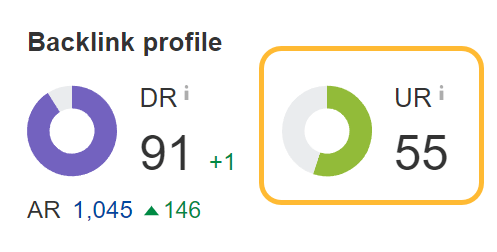
Generally speaking, the more internal links a page has, the higher its PageRank. However, it’s not all about quantity—the quality of the link also plays a vital role.
As well as passing authority, internal links allow visitors to jump straight to the content you want to show them, allowing you to control the user experience.
For example, if you run an e-commerce store, you may want to link to your best-selling or seasonal products directly from your homepage. This is helpful for visitors who want to jump straight to the products and purchase them, and also creates a good user experience by creating a strong internal linking structure.
You should look at it in a strategic way and think about what you care about the most, and how you can highlight that with your internal links.
Google and other search engines also use internal links as signposts to help discover new pages on your website.
For example, let’s say that you publish a new webpage and forget to link to it from elsewhere on your site. Assuming the page isn’t in your XML sitemap and doesn’t have any backlinks, Google will find this page hard to discover.
Here’s what Google has to say about this:
Some pages are known because Google has already crawled them before. Other pages are discovered when Google follows a link from a known page to a new page.
Internal links can also provide context for search engines like Google. They do this through anchor text.
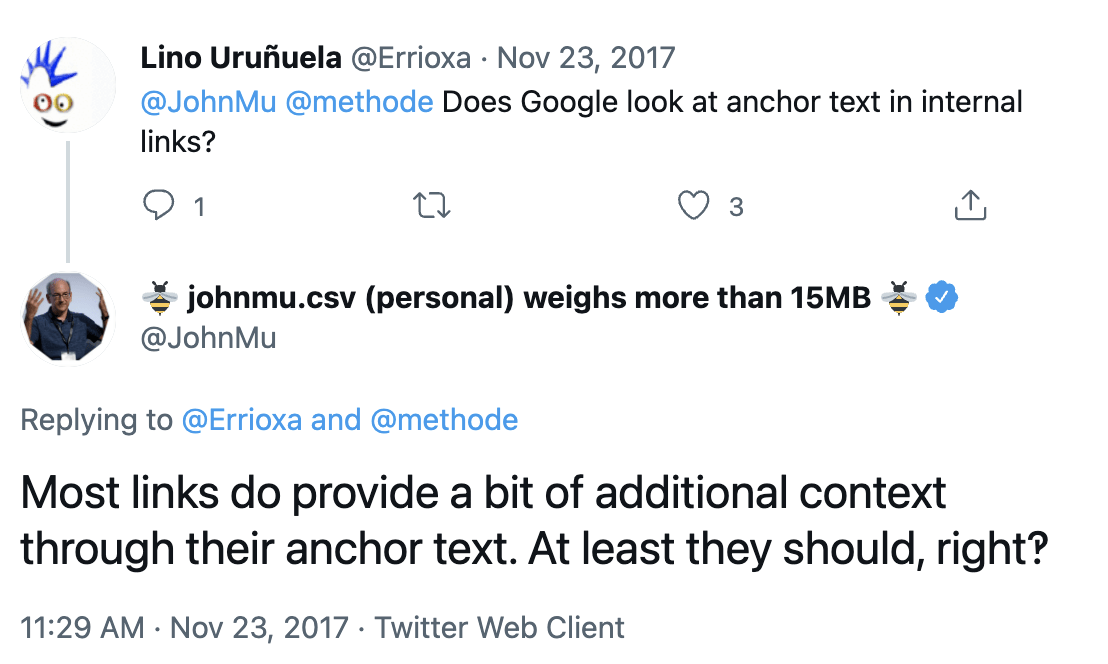
In other words, if you have a page about red dresses and have multiple internal links pointing to that page using descriptive anchor text like “dresses,” “red dresses,” and “red maxi dresses,” those help Google to understand the context of the linked page.
Here are the main types of links you’ll see on the web.
Navigational links
Most visitors to your website find their way around using your site navigation. These are some of the most important internal links on your website.
Here’s what they look like on the Ahrefs website.

Contextual links
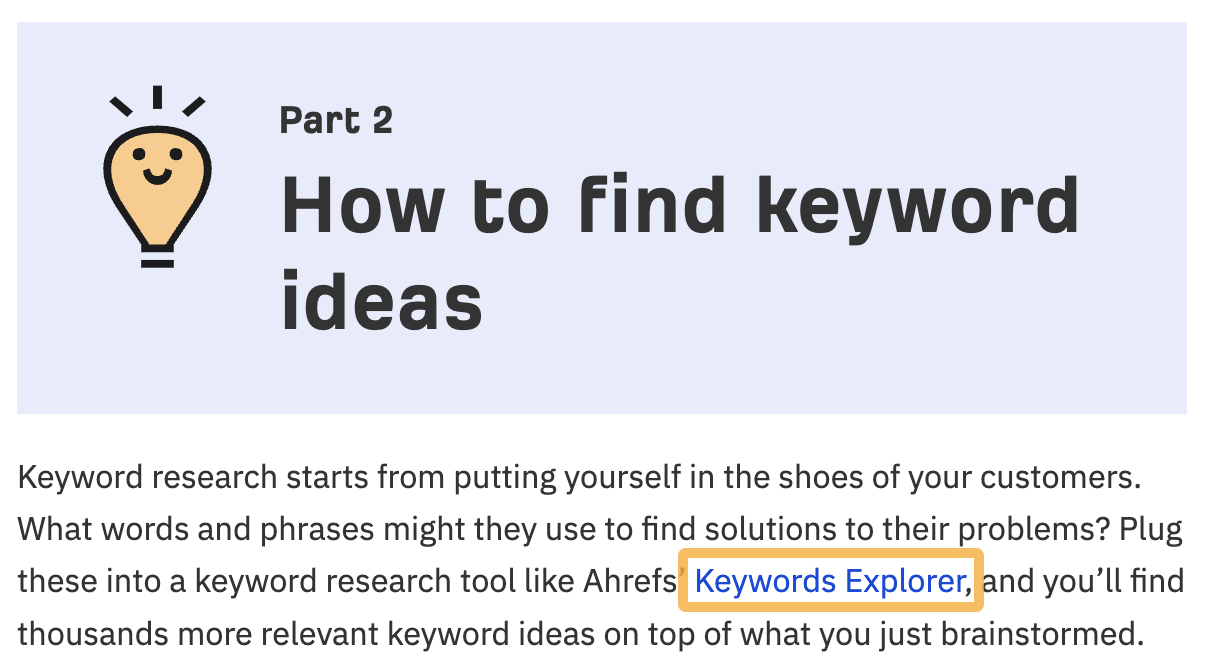
Contextual links appear in the main body of the content on a webpage. They’re typically used to expand on ideas, refer to resources, define terms, or direct readers to other relevant content.
Here’s an example of a contextual link to our keyword research tool:
Breadcrumb links
Internal links can also be used to indicate relationships between pages. One of the best examples of this is breadcrumbs. Breadcrumbs allow users to trace their journey back to the homepage.

They’re typically placed at the top of internal pages like product pages or blog posts.
Google has also indicated that it treats them as normal links (as part of PageRank computation).
We likes them. We treat them as normal links in e.g. PageRank computation
— Gary 鯨理/경리 Illyes (so official, trust me) (@methode) June 22, 2017
Footer links
These appear at the bottom of the page. Here’s an example of the footer links in Ahrefs’ blog.
Footer links typically include links to your contact page, privacy policy, and other important pages on your website.
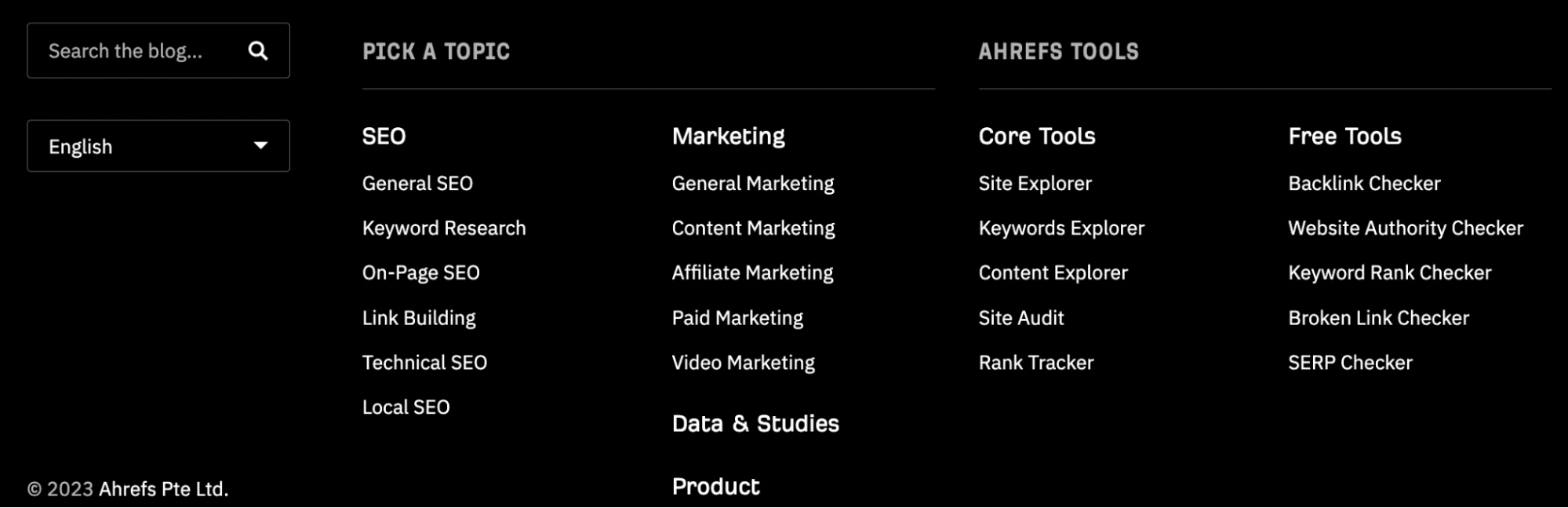
While footer links are useful for extra detail, they’re not the primary method of navigation on most websites.
Related content sections
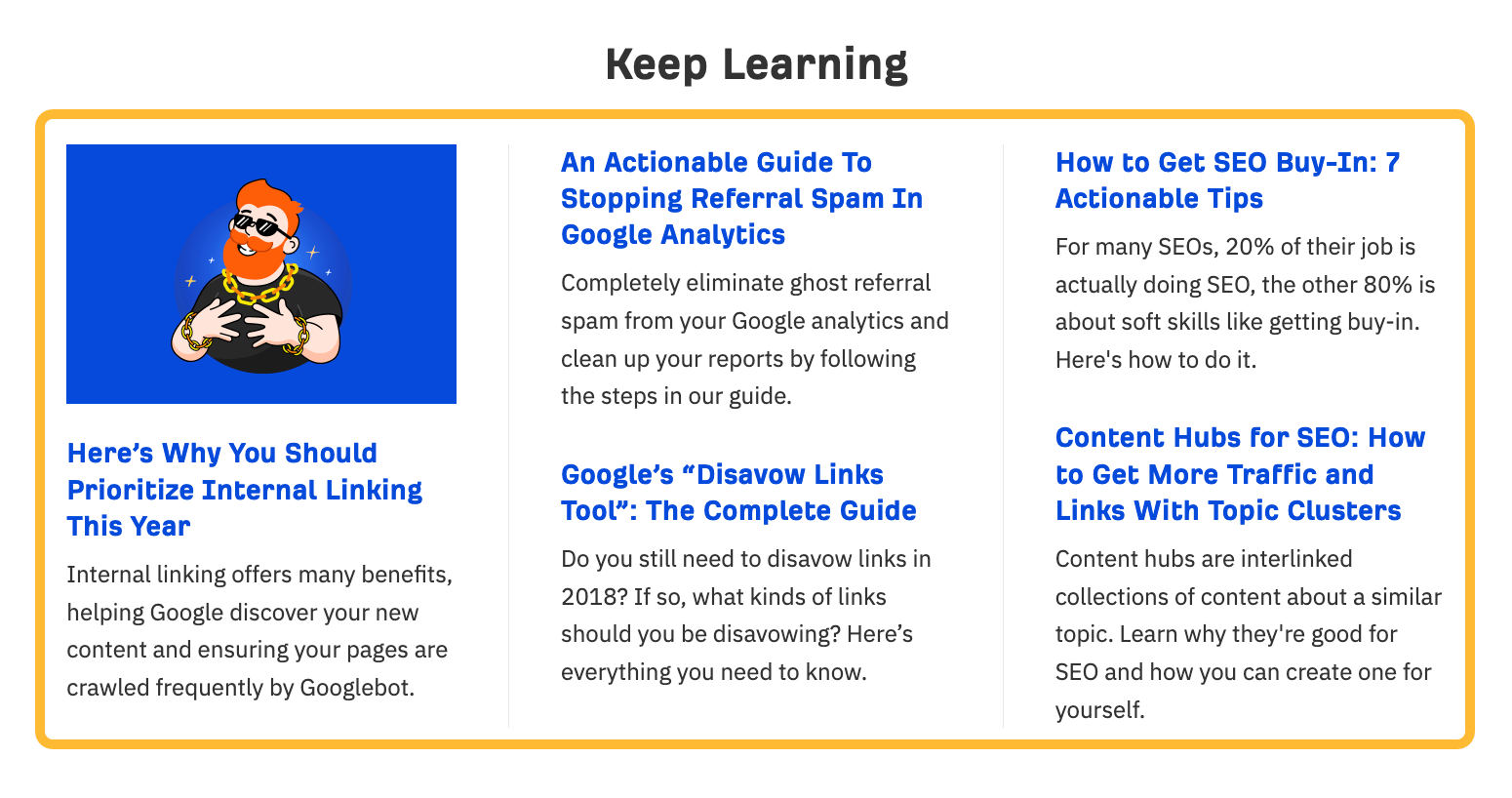
Related content modules—at the end of posts or in sidebars—keep users engaged and spread authority horizontally across your site. They’re especially useful for surfacing older content that remains relevant.
On our blog, we do this through a “Further Reading” box that links to related articles.
Setting up a solid internal linking structure helps your website rise through the ranks by directing authority to the right places. Here are the internal link best practices at a glance:
- Plan your site structure using a pyramid hierarchy; keep every page within three clicks of the homepage.
- Organize content with a mix of topic clusters and siloing.
- Link to the pages you care about most—your key products, services, or cornerstone content.
- Link to contextually relevant content that genuinely helps the reader.
- Write descriptive, varied anchor text instead of generic phrases like “click here.”
- Place your most important links in the main content body, early in the page.
- Keep it intentional: 3–5 contextual links per article is a good starting point.
- Add internal links when updating older content to connect it to newer material.
- Get pagination right with real HTML links and proper canonicalization.
- Make sure crawlers can see your links: keep them dofollow, maintain mobile parity, and use absolute URLs.
Let’s walk through each of these in detail.
1. Plan your internal linking structure
If you’re starting a new site or even restructuring an old one, the first step is to plan your internal linking structure.
The pyramid structure is one of the most popular structures for internal linking, as it naturally creates a top-down internal linking structure.
Here’s an example of what it looks like. The arrows show the internal links from page to page.
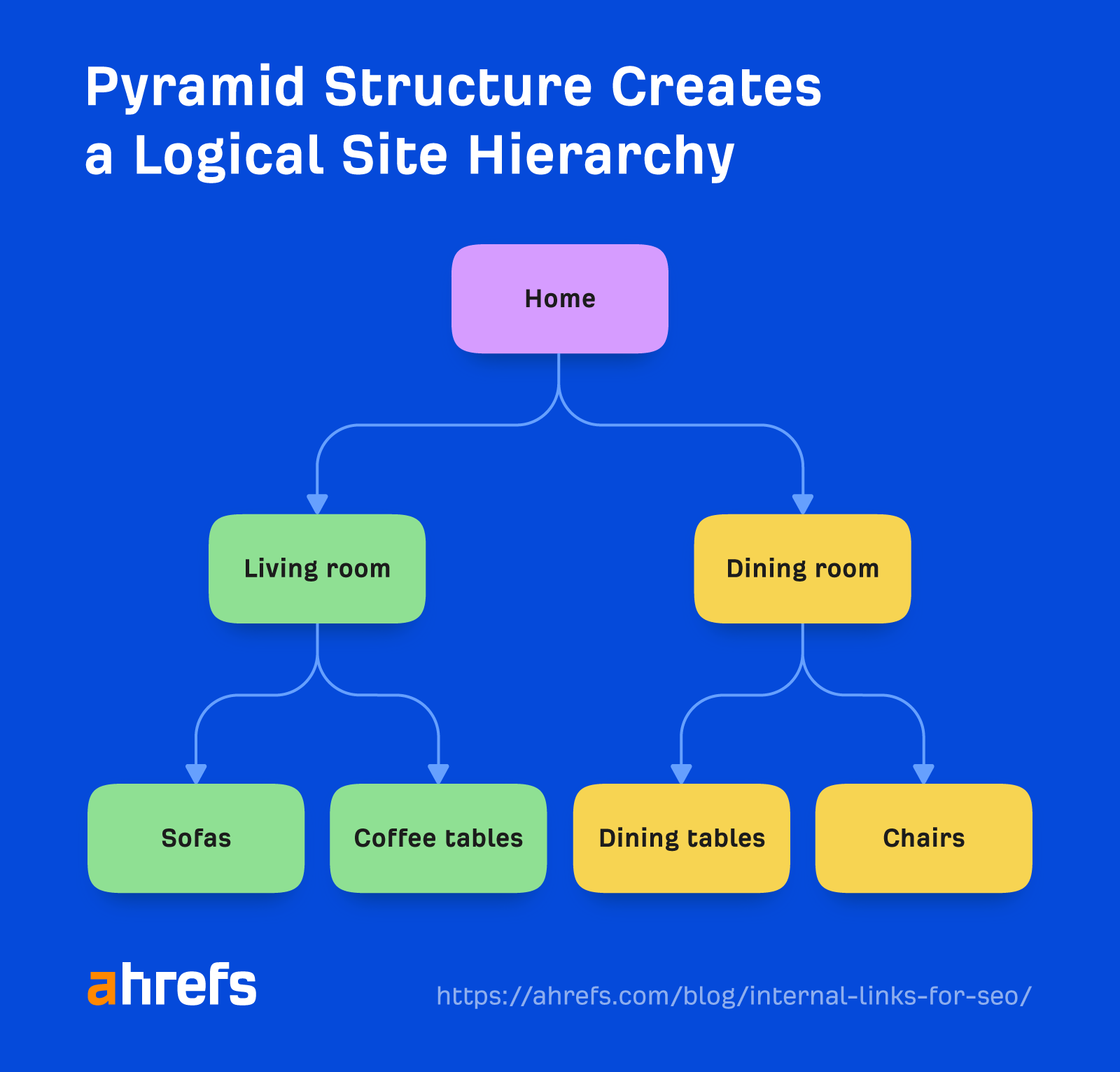
Creating a basic internal link structure is the first stage in starting a successful internal linking strategy. This approach has also been recommended by John:
The top-down approach or pyramid structure helps us a lot more to understand the context of individual pages within the site.
As well as the top-down linking approach, you can also add breadcrumbs to make it easier to navigate around your website.

Breadcrumb links enable visitors to understand where they are on the website and to trace their journey back to the homepage.
2. Organize content with a mix of topic clusters and siloing
You’ll often hear two terms here: content silos and topic clusters.
A silo is about folder structure—grouping pages under a shared URL path.
example.com/seo/

├─ example.com/seo/keyword-research

├─ example.com/seo/link-building

├─ example.com/seo/technical-seo
A topic cluster is about the linking network—a pillar page linked reciprocally to a set of related subtopic pages.
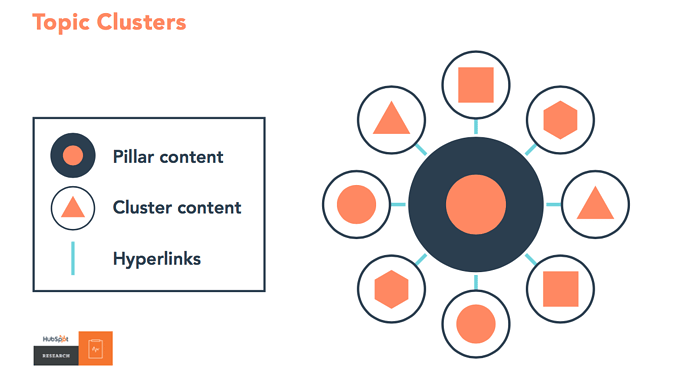
Both help Google understand topical relevance; they just approach it differently.
In practice, most strong sites today combine both. You’ll have a clean URL structure like /seo/keyword-research or /seo/link-building, but those pages also link across topics where it’s useful. This is what you see on sites like Ahrefs or Hubspot.
Think in topic clusters first and use clean site architecture as support—not a strict silo system. Strict silos discourage linking between sections, which means you miss out on passing authority and context across related topics. Clusters give you the same topical relevance signals without those artificial walls.
3. Link to internal pages you care about
Once you’ve planned the basics of your internal linking structure, it’s time to start linking to the internal pages of your website you want to highlight.
For ecommerce businesses, it could mean their key products or services. For publications, it could be their most important content on a particular topic.
At Ahrefs, we usually internally link to our SEO tools from our key pages.
Here’s an example of this from Ahrefs’ homepage, showing our core SEO tools are prominently linked to using internal links.
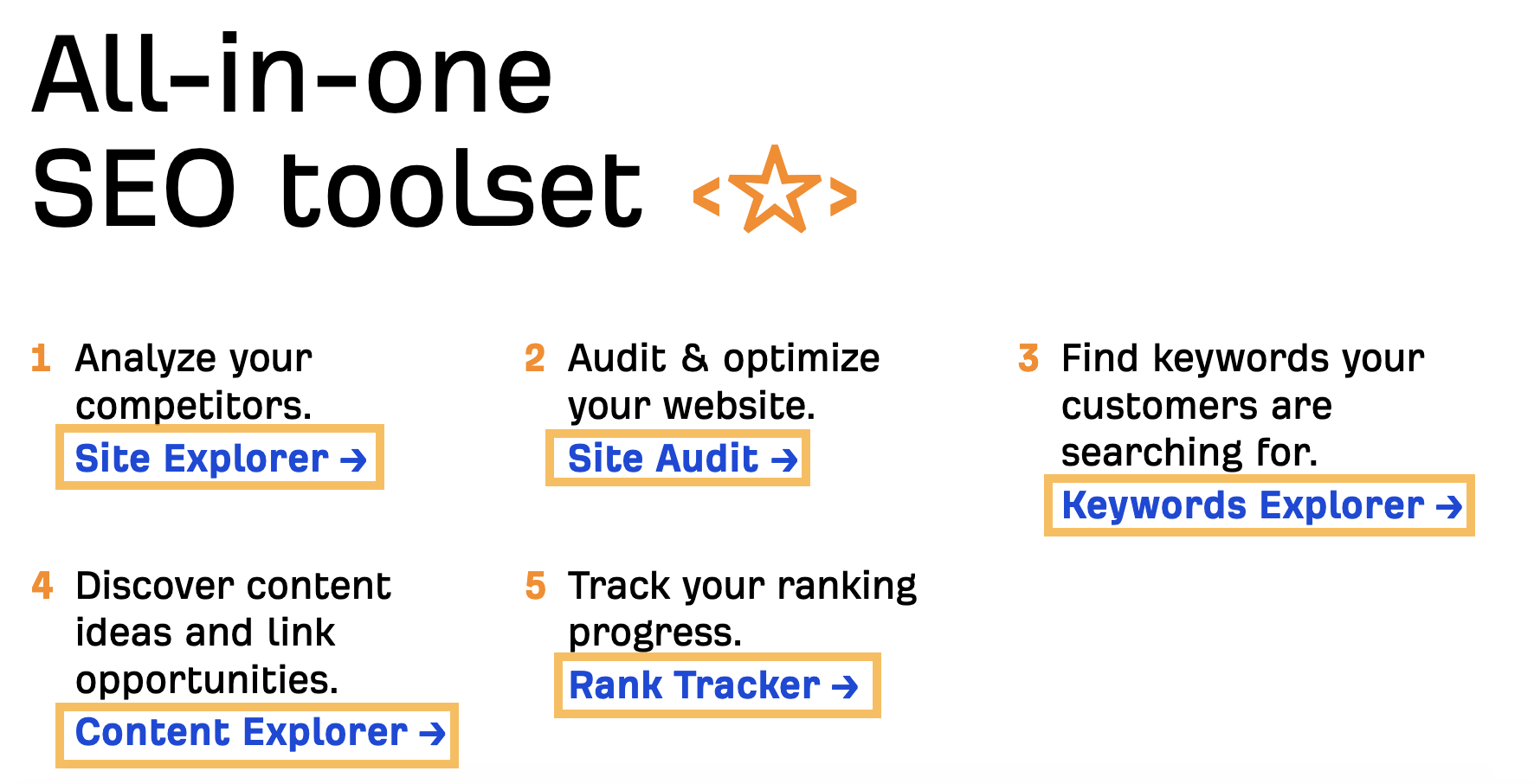
This approach helps guide visitors to some of the most important parts of our site architecture.
You can link to whatever you like, but it’s best to link to the things on your website that you care about the most.
4. Link to relevant content
Internally linking to content that’s contextually relevant on your site helps provide extra information for the readers about the topic you’re writing about.
For example, when writing about SEO, the reader may encounter some technical jargon that they may not necessarily understand—but the internal link helps to provide context.
Here’s a quick example:

This approach enables the reader to click on the link to learn more about that topic.
On our blog, we also link to relevant content through a “Further Reading” box that looks like this:

This is another method you can use to help point readers to relevant content on your website.
Another consideration with internal linking is the context of the link. Gael Breton believes that:
In content, as long as it contextually makes sense to link to another page of your site, you should do it.

Here’s an example of what this can look like on an ecommerce website.
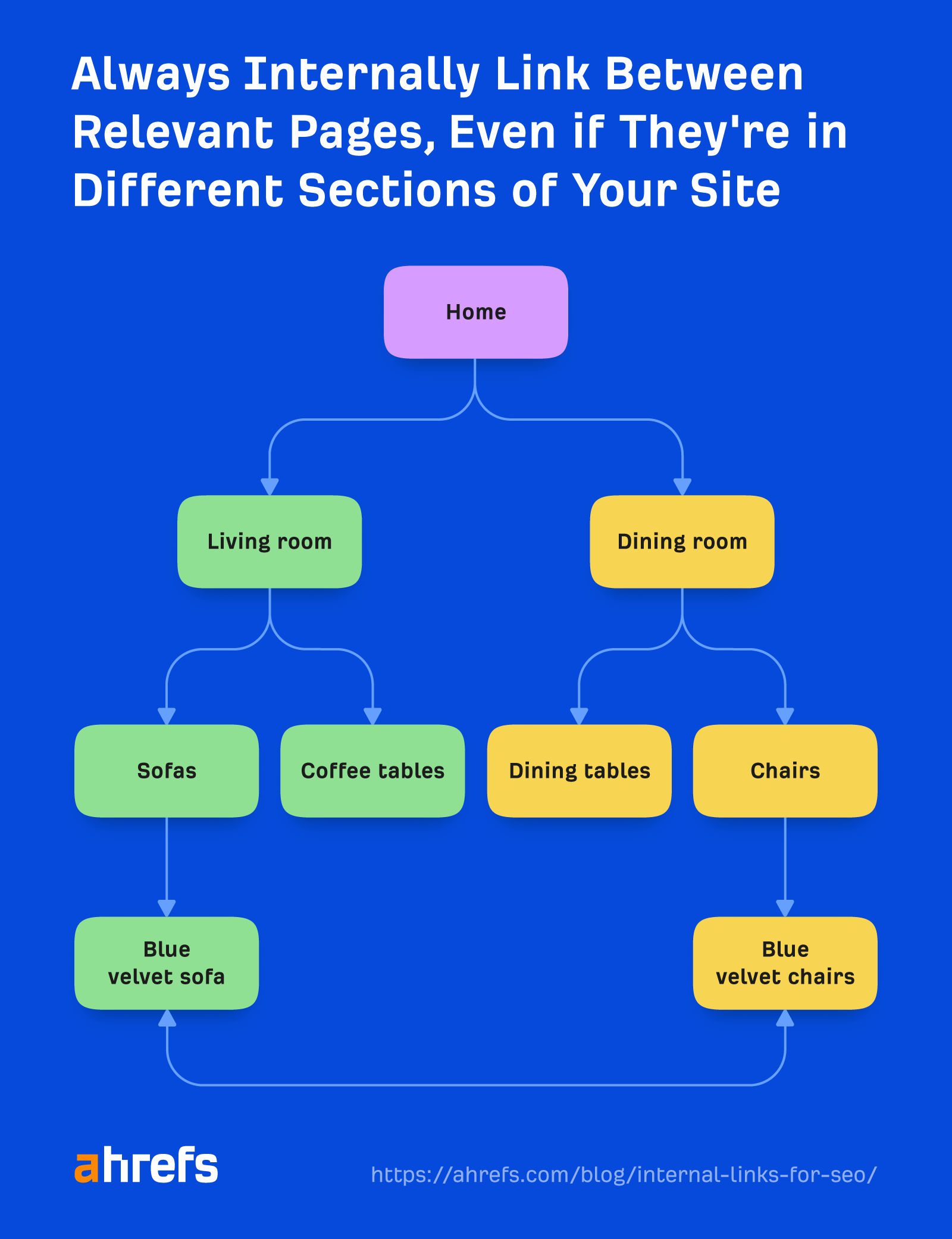
As well as being contextually relevant, it’s worth considering how powerful the pages you’re linking from are.
Let’s say you’ve just written a new post and you want to add some powerful internal links to it. What’s the best way to do it?
Here’s how I’ll approach it for free using Ahrefs Webmaster Tools:
- Head over to your most recent Site Audit and click on Page Explorer
- Enter your keyword into the search bar (e.g., “online advertising”)
- Change the filter to Page text (page should update once you’ve clicked it)
In this example, there are 21 results. You can then sort the pages by organic traffic. This enables you to see the pages with the most traffic first—likely to be powerful pages.
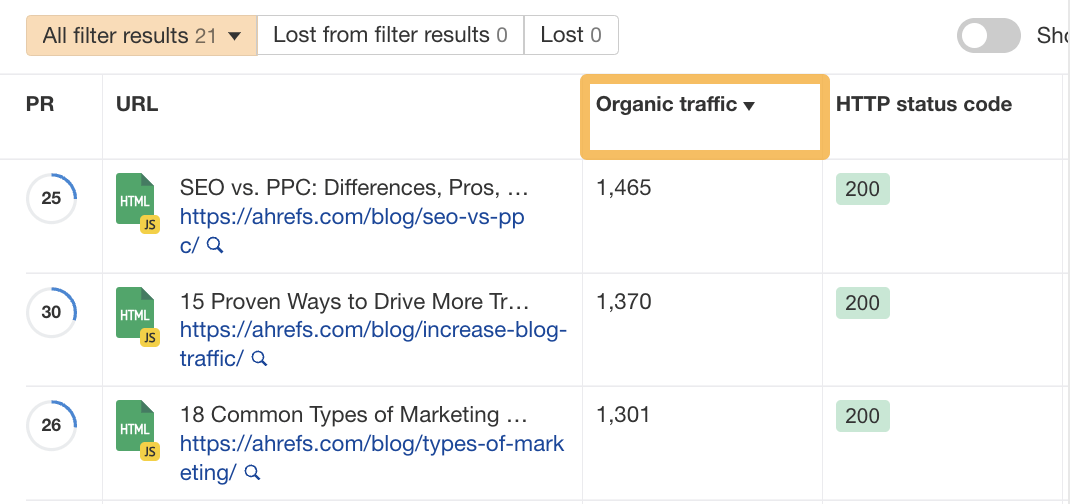
Once you’ve got your list, it’s just a question of working through it and adding the internal links to your new page to these powerful pages.
5. Write anchor text that describes the destination
The clickable text in your links tells search engines what the target page is about. This is an easy win that a lot of people overlook.
“Click here” wastes an opportunity. “Our guide to email segmentation” tells both users and search engines exactly what they’ll find. So be descriptive.
It’s also a good idea to vary your anchors. Linking to the same page with identical anchor text every time looks unnatural. Use variations: “email marketing strategies,” “building your subscriber list,” and “effective email campaigns” can all point to the same page while covering different keyword angles.
6. Place important links where they’ll be seen and clicked
Search engines weight links based on how likely users are to click them—a concept called the “reasonable surfer” model. Not all links on a page carry equal value:
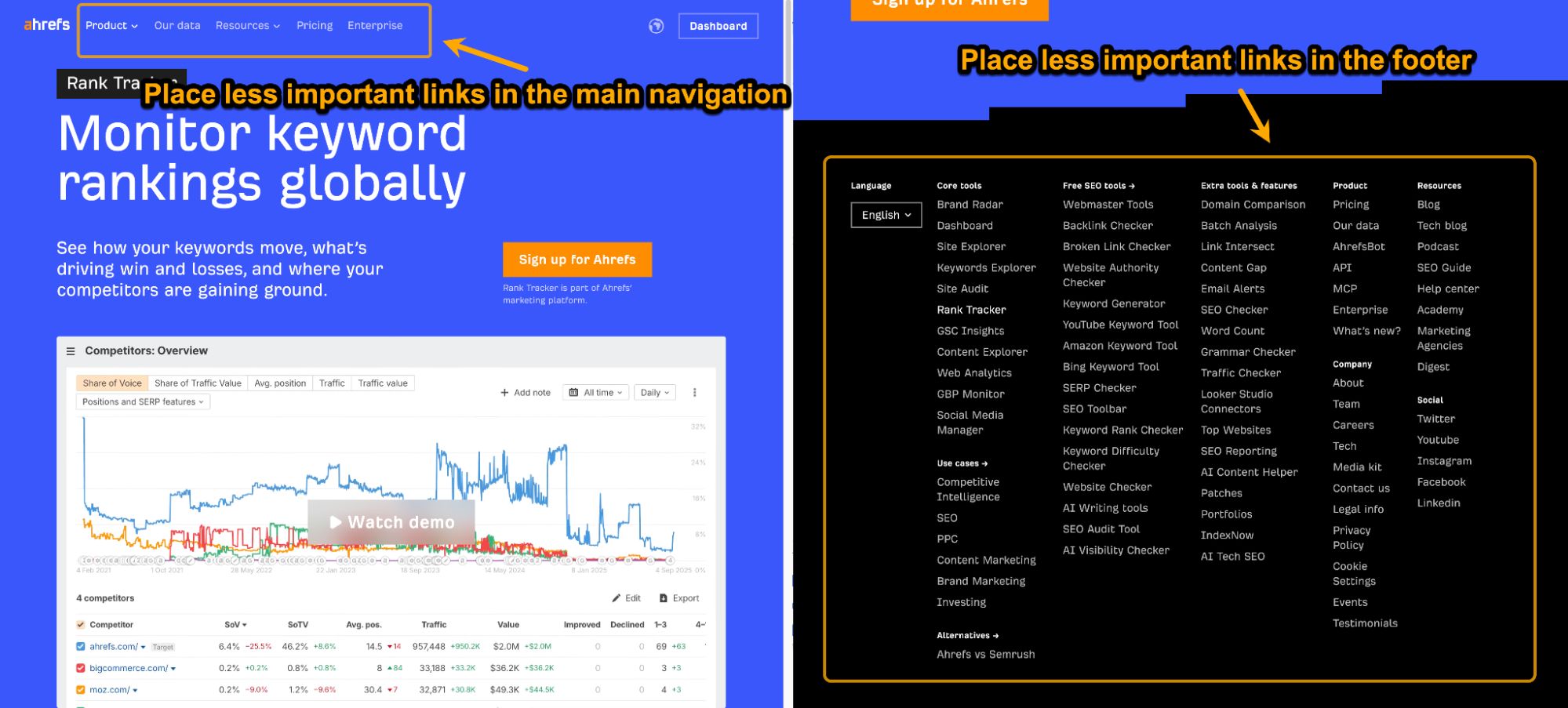
- Highest value: Links in your main content body. These are contextual, editorial, and positioned where engaged readers will actually click.
- Medium value: Navigation and breadcrumbs. They matter for structure but are discounted as template elements.
- Lowest value: Footer links and deep sidebar content. Users often ignore these areas, and algorithms have adjusted accordingly.
Place your most important internal links early in the content, above the fold when possible. The same goes for the links on your homepage.
7. Link intentionally, not excessively
One of the most common questions SEOs get is how many internal links a page should have. There’s no magic number, but for a typical article, I’d say 3–5 contextual links work well alongside your standard navigation. It’ll depend on the length and depth of your content, but that’s a solid starting point.
The reason you don’t want to go overboard is that every link on a page dilutes the value passed through the others. A page with 100 links passes roughly 1/100th of its equity through each one.
So yes, too many internal links can hurt your SEO—not just because of diluted PageRank, but because excessive linking can make your content harder to read and may signal to search engines that you’re prioritizing optimization over user experience.
Ask yourself this simple question: does this link genuinely help someone understand the topic? If not, cut it.
8. Add internal links when updating content
Publishing new content doesn’t automatically connect it to your existing library. Building those bridges is one of the highest-impact SEO habits you can develop. So, when refreshing old articles, look for opportunities to link to the pages you’ve published since.
Start by leveraging your power pages—the ones with the most external backlinks. Adding internal links from these high-authority pages to newer or underperforming content channels where you need the authority most.
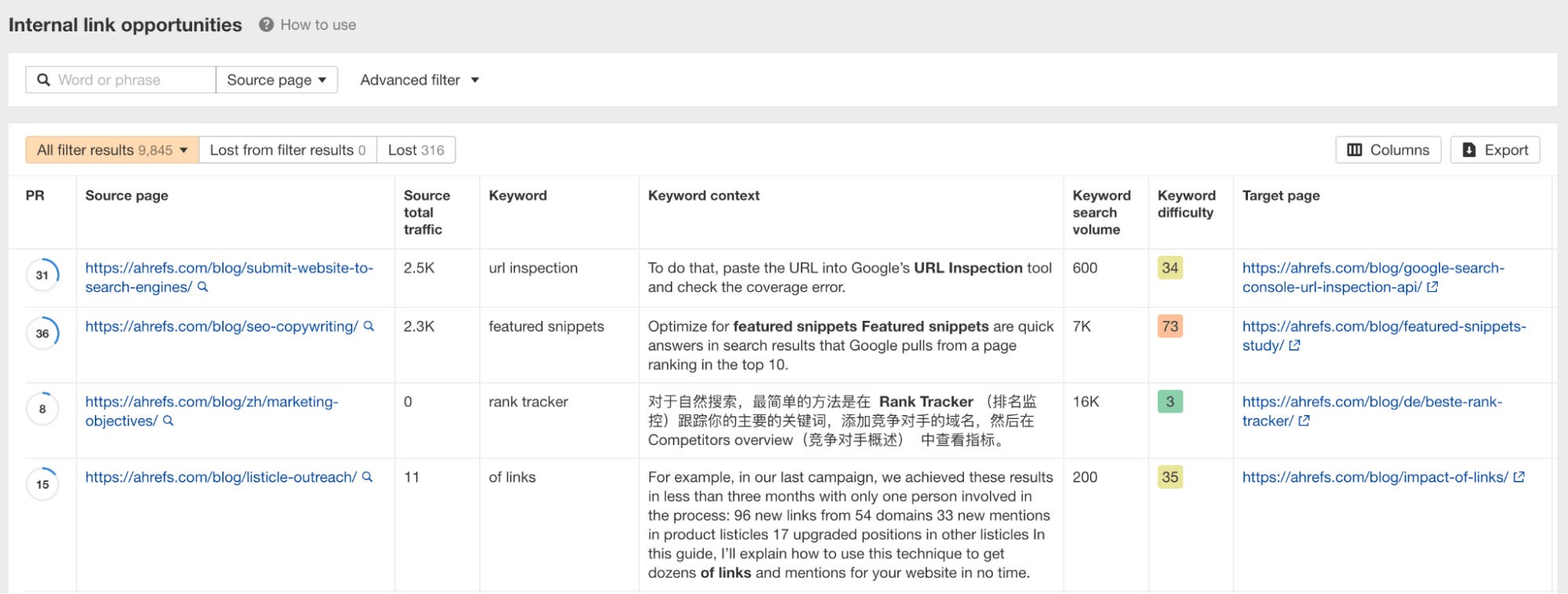
Ahrefs gives you a shortcut to this—the Internal link opportunities tool in Site Audit. It shows which pages to link together based on the top 10 keywords (by traffic) for each crawled page.
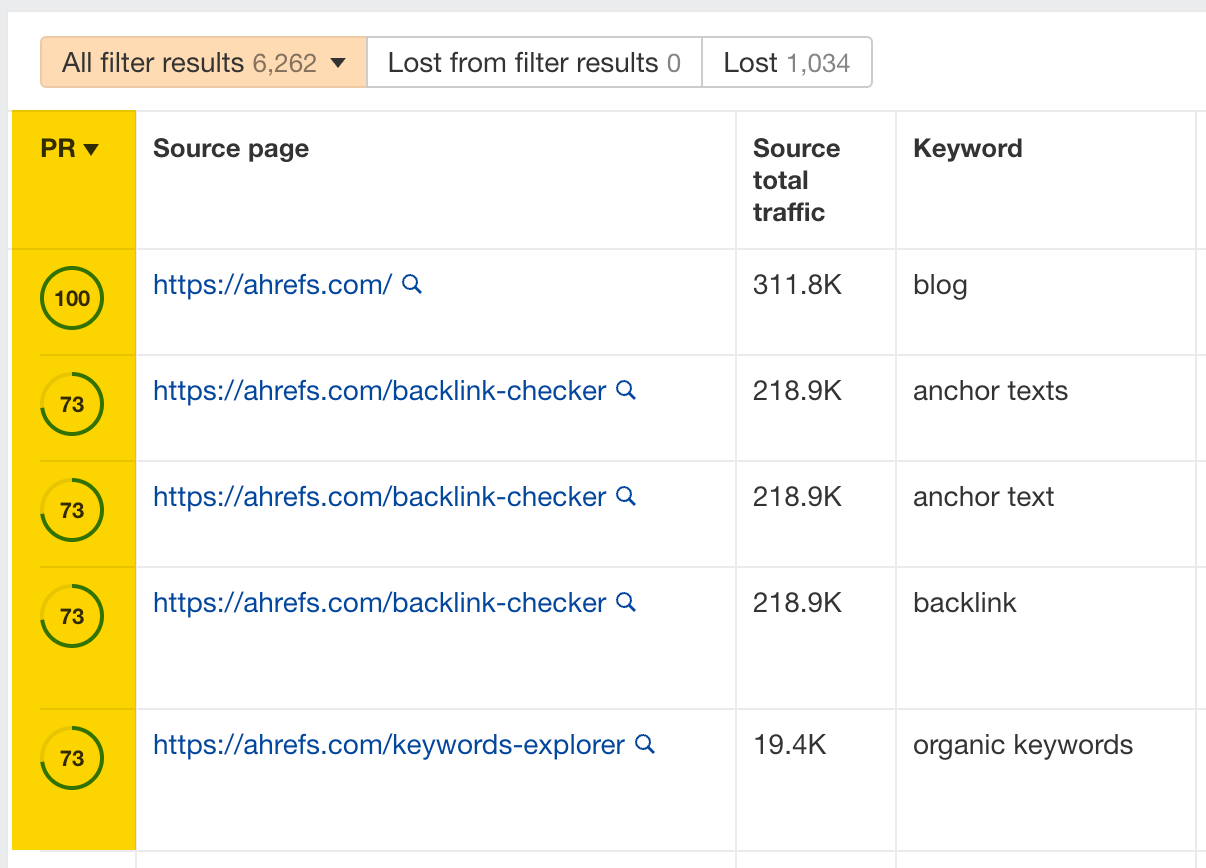
Your power pages will be the ones with the highest PR numbers.
 And if you’ve written extensively about a topic without organizing it, consider building clusters retroactively—create a pillar page and update all related posts to link to it and to each other.
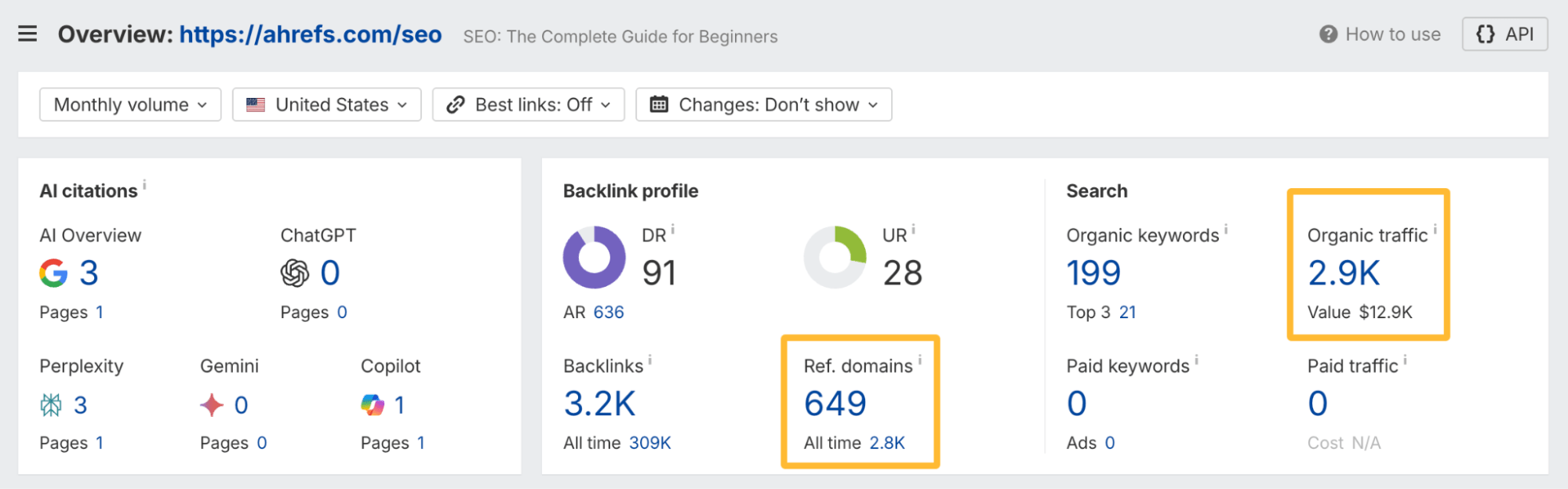
That’s what we did with the Beginner’s Guide to SEO pillar page.
 That page alone brings an estimated 2.9K organic visits each month and earned backlinks from 649 unique domains (and some AI citations, too).
 9. Get pagination right
For sites with large archives, product catalogs, or category pages, pagination is a form of internal linking that’s easy to get wrong.
Use real HTML links. Pagination controls should be actual <a href> elements, not JavaScript buttons or onclick events. Crawlers can struggle to execute JavaScript, which may leave paginated content undiscovered.
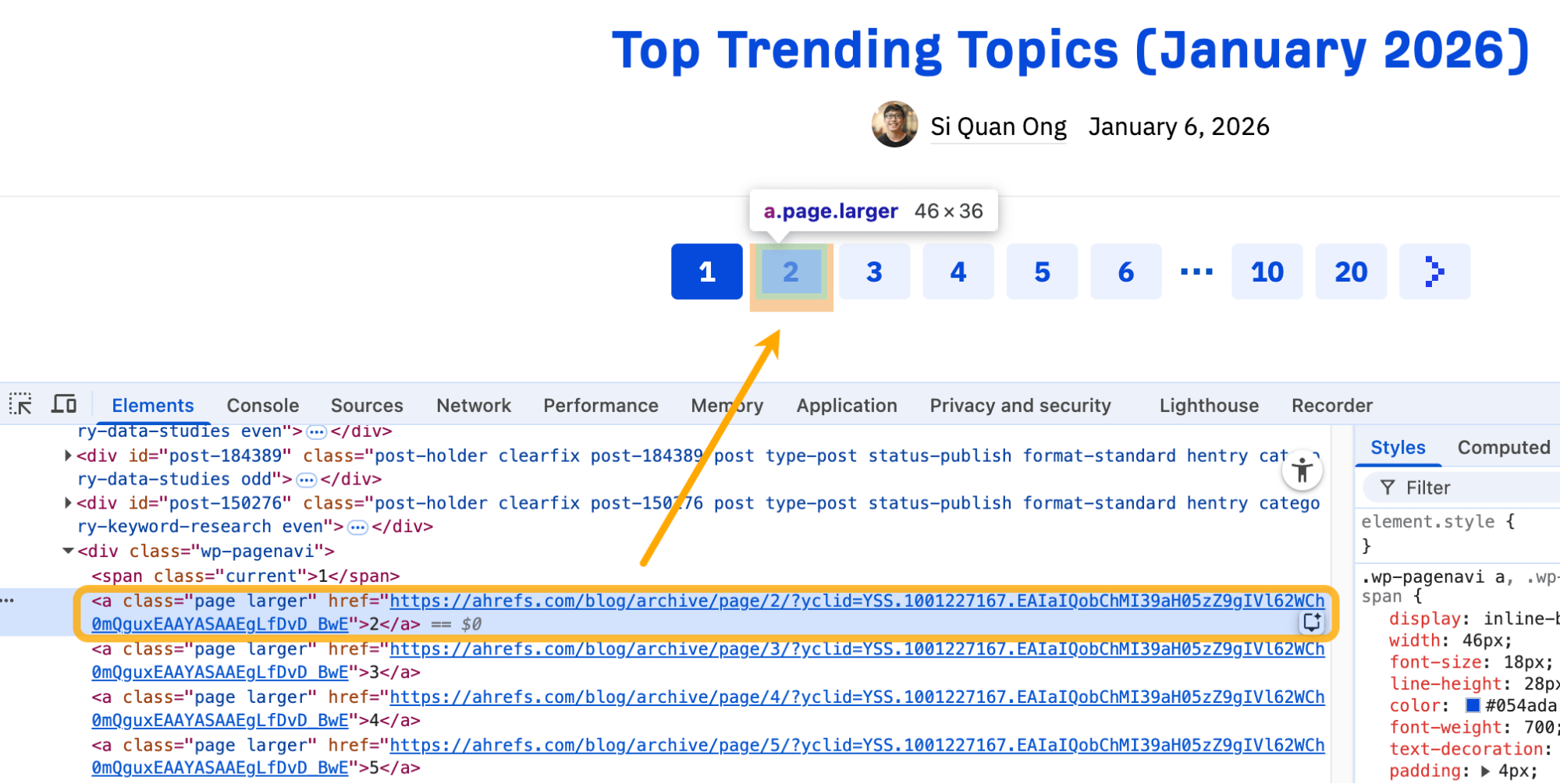
Also, don’t canonicalize paginated pages to page 1. Page 2 contains different content than page 1—telling search engines they’re duplicates can get content on deeper pages de-indexed. Each paginated page should be canonical to itself.
10. Make sure crawlers can follow your links
All the internal linking work in the world won’t help if search engines can’t actually see or follow what you’ve built.
Unless you don’t want a page to be available on search engines, keep internal links dofollow. Internal links should be dofollow by default so they can pass value between pages. Only use nofollow for pages that don’t need to be indexed, like login pages, admin sections, or filter pages that create duplicate URLs.
To find pages pointing to internal pages with nofollow links automatically, you can use Ahrefs’ Site Audit. Simply go to the All issues report, and look for “Page has nofollow outgoing internal links.
To stay on top of your SEO game, you’ll need to audit your internal links on a periodic basis.
Manually checking your internal links one by one is time consuming and, for bigger sites, almost impossible.
The best solution is to use a tool like Site Audit, which allows you to schedule the crawls of your website on a daily, weekly, or monthly basis.
With this tool, you can:
- Fix broken internal links to 4XX pages.
- Identify opportunities for new internal links.
- Fix orphan pages.
Let’s take a look at how to do these things.
1. Fix broken internal links to reclaim authority
Once you’ve run a Site Audit crawl, head over to the Internal pages report and click on “Issues.”
In the above example, we can see there are some issues. Let’s click on the “4XX page” to look at one issue in more detail.
We can see this issue has been caused by a blog post that we took down but still has 37 internal links pointing to it.
If the page was permanently removed, you’d need to remove the internal links pointing to this 404 page.
If the 404 page had important external links pointing to it, then you might want to consider 301 redirecting the page. To check this, you can use Ahrefs’ Site Explorer’s Broken backlinks report.
If we plug in the exact URL and then head over to the Broken backlinks report, we can see this page actually has quite a few external links pointing to it.
As a result of this check, we might want to consider 301 redirecting this page to a near equivalent.
2. Fix orphan pages
Orphan pages are pages with no internal links.
If you have important pages on your site that are classified as orphan pages in your Site Audit report, then you have an issue.
The good news is that it can be solved by simply adding a new internal link to the orphan page(s) in question.
Once you’ve run your audit, you can see if you have any orphan pages by:
- Clicking on the Links report.
- Then selecting the “Issues” tab.
Site Audit > Links > Issues tab > Orphan page (has no incoming internal links)
In the example below, we can see this site has one orphan page.
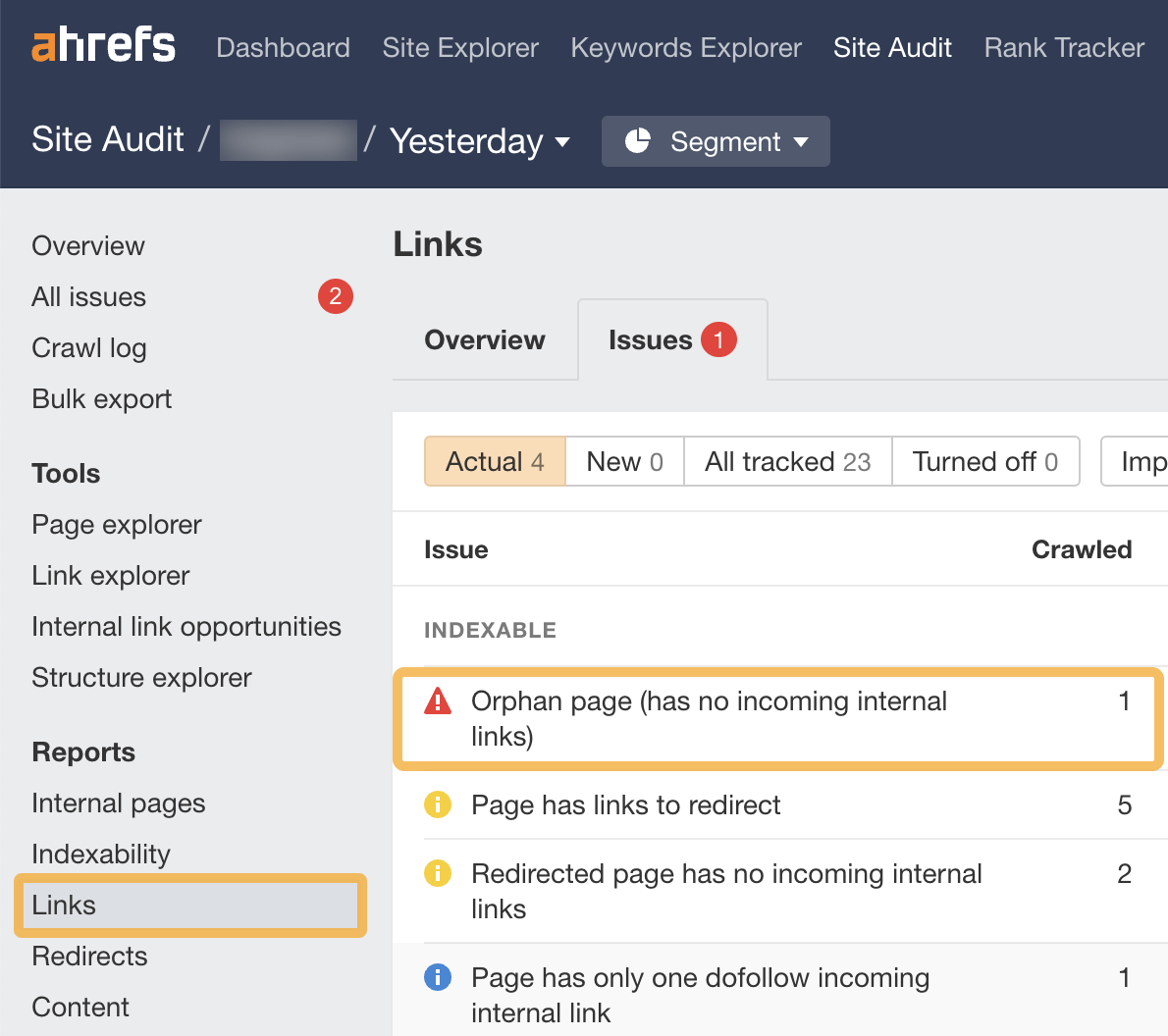
No important pages should be orphaned for two reasons:
- Google won’t be able to find them (unless you submit your sitemap via Google Search Console or they have backlinks from crawled pages on other sites).
- No PageRank will be transferred via internal links—as there are none.
Skim the list and make sure no important pages appear here.
If you have a lot of pages on your site, try sorting the list by organic traffic from high to low.
Orphaned pages that still receive organic traffic would likely get even more traffic if internally linked to.
3. Identify opportunities for new internal links
Finding new internal link opportunities is also another time-consuming process if it’s done manually, but you can identify them in bulk using Site Audit.
To do this, click the Internal link opportunities report in Site Audit.
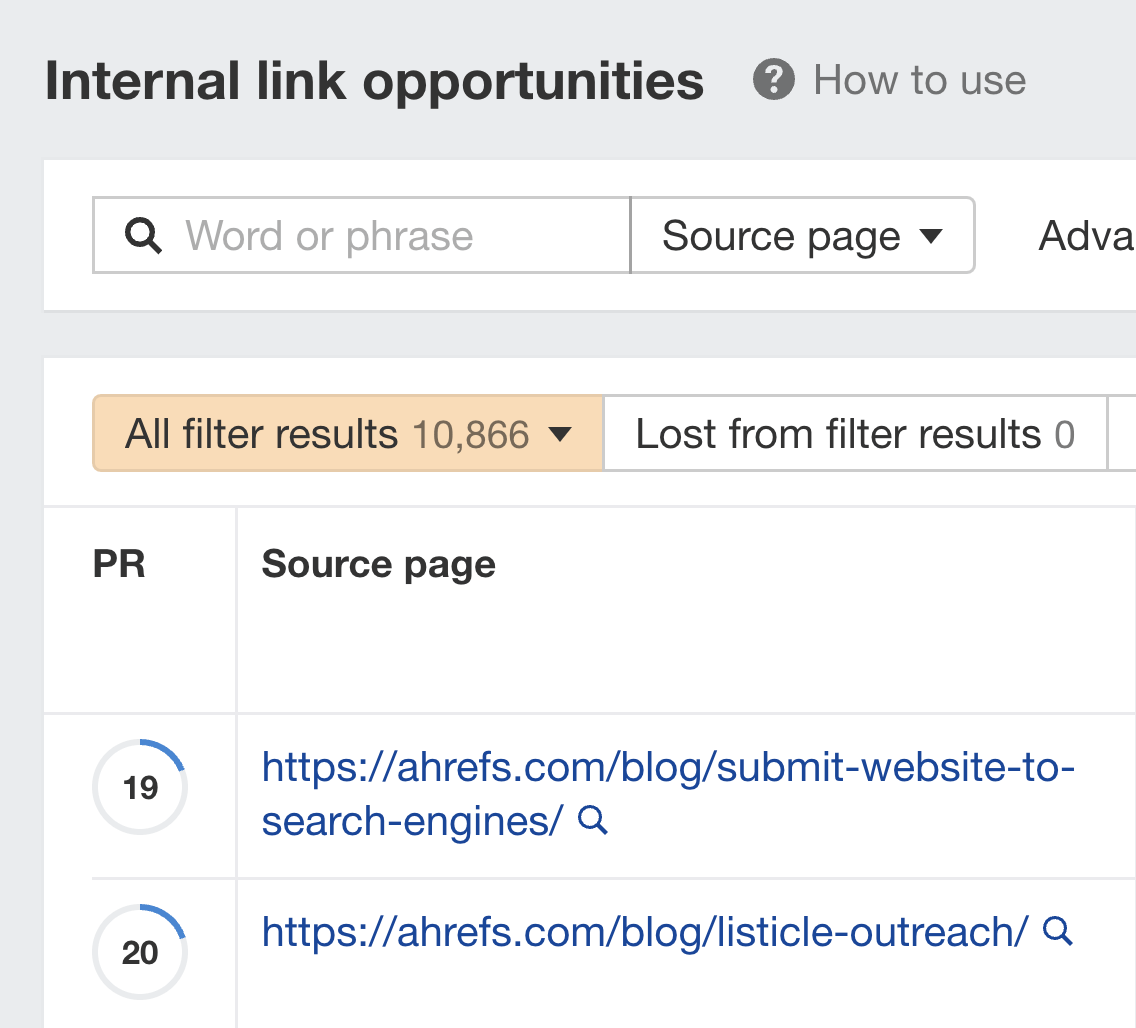
You’ll see a bunch of suggestions on how to improve your internal linking using new links.
The best bit about this report, in my opinion, is that it suggests exactly where to place the internal link.
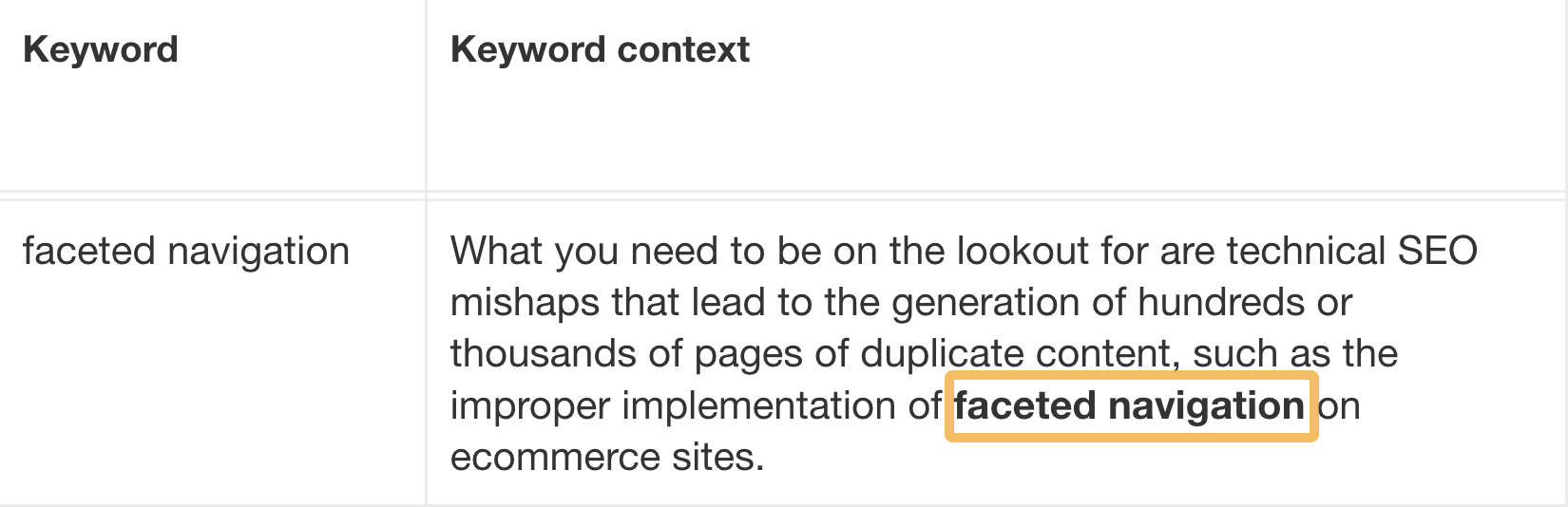
In the example above, Site Audit is suggesting in this passage of text that we should add a link to our page on faceted navigation.
I’d advise reviewing the recommendations and adding links to the most important pages you want to highlight.
Final thoughts
Internal linking isn’t technically difficult, but it takes time and patience to execute your plan. Also, making changes to your site can cause more issues—which, if left undiagnosed, can impact your site’s performance in search engines like Google.
In my opinion, the only sustainable way to monitor your internal links is by using a tool like Ahrefs’ Site Audit.
Got questions? Ping me on Twitter.